Hi, I'd like to wish every one of you a happy new year!
The new year's celebration here in Ecuador is really fun and different. I daresay it's one of the most widely celebrated holidays here.
I'll tell you all about it in future posts, along with what we did for Christmas and the nine days leading up to it.
Looking back, I personally had a very nice, comfortable year. I liked 2008.
HAPPY 2009!!!
~Joey
Wednesday, December 31, 2008

Wednesday, December 24, 2008
My Lucky Boxers
OK, so here's the deal: Almost a week ago I wrote up a nice big blog post but then lost it all. Now I've got some free time again and have decided that instead of throwing one big post at you about the end of the school year and Christmas and all that jazz, I'm just going to put up a few smaller ones and they may come relatively frequently, so if that happens try to keep up. I think one of my big problems lately is I have so much to say I feel like I have to squeeze it all into one post, but really what I should be doing is writing little blurbs as I find time. That way you guys don't have to wait a month between posts and it doesn't become a day-long project for me.
My previous lost post started something like this:
"Hello, all! I hope all of you up north are enjoying the weather. Down here it's a brisk 17 degrees. Oh wait, that's in Celsius, let's see, that would make it about 55 F on this lovely Christmas Eve night. Not too shabby."
And it went on to say something along the lines of:
Well I of course by now have finished up all my school and don't have to go to another real class until Spring quarter starts up back at K, which is March 30. My exams and final projects all went fairly well, but they almost didn't. Here's the story:
As some of you may know, this semester I took a Herpetology class, that's the study of reptiles and amphibians, not a common STD. Well I must say that this class was quite the challenge, even by K standards, and it didn't help that we were used to all our other classes being easy as pie.
For the better part of a month, I'd been working on an experiment for the class testing the effects of fertilizers on tadpole growth and development. On Wednesday, the 17th, not only did we have due the final draft of the paper for our projects, but also a poster for it AND we had the final exam of the class to worry about.
We had turned in the rough drafts the week before, and the prof said he'd return comments within a few days, so I decided to wait until then to correct my paper. As it turns out, he didn't send any word back on our papers until the 15th, 2 days before our final drafts. His e-mail (written to all of us in the class) simply stated that the rough drafts look good and that we should remember to look over the guidelines in the (12-page) syllabus to make sure our final format is correct. Personally I was looking for something a little more substantial, so I sent him back and e-mail asking for clarification on my specific paper. I knew, though, that I'd have to start off just revising it on my own until he sent word.
Fast-forward to Wednesday morning. The test wasn't until 4:30 that afternoon, so I had a good chunk of time to put the finishing touches on my final draft of the paper and come up with a poster. The test was open-note, open-book, open-computer, just not open-classmate, so I didn't have too much to worry about studying for that. But even without worrying about the test, I still had a pretty full plate. During this particular morning, I made some not-so-wise decisions. The biggest mistake was when I told my host father that I'd help him with a little job he had. He said it would take less than an hour, and that it would help him so much if I came along because his normal guy wasn't around to help. Before heading out with my father, I changed out of my pajama pants into my clothes for the day, including my lucky boxers. I figured I could use all the luck I could get.
Well this less-than-one-hour job turned into a 2 and a half hour job, after travel distance, traffic, and other errands were taken into account. I was really worried when I got back. I shoveled down my lunch and went to work, but at this point it was useless. I had gotten my paper done, but the poster still needed a ton of work. The one hope I had was knowing that my prof often allows work to be turned in via e-mail until midnight. Maybe it would work for the poster as well. By the time it was time to leave the house, I was scrambling around like crazy. I ended up leaving the house a few minutes late, and wasn't happy to see those few minutes of lateness grow into more and more minutes of lateness as my buses seemed to refuse to come as frequently as usual, and traffic was crazy. The whole way there, I was throwing temper tantrums in my head because I was so frustrated at how late I was and how I didn't finish all the work. By the time I got to the classroom I was almost a half an hour late to the exam. I wondered if my lucky boxers had run out of luck.
When I entered the classroom, however, I first heard people chatting and laughing. I saw that no one had a test out in front of them. What was going on? I sat down grumpily in my chair and asked my buddies what the story was. They said that our teacher was having problems in the copy room printing the tests. To my luck: half an hour's worth of troubles in the copy room. When he finally came to administer the test, he said that people who did a project were allowed to omit certain parts of the test. Sweet!
I took that test and felt good about it. Afterwards I turned in my paper with pride, and calmly stated that I had no poster when he asked for one. He very reasonably replied that it was OK, and that he expected a digital version by midnight and a printed version by the next morning. Can do. Everything was looking up. I had been feeling really crummy all morning and early afternoon, just trying to make it through the day with this dark thunder storm over my head. But by now, the storm had mostly passed and I could see that things would turn out alright. As I was about to leave, the prof said, "Oh, Joey, I'm going to have to talk with you."
Uh oh, I thought, what trouble am I in now? "Why is that?" I asked.
"Because," he responded, "we're going to publish your paper."
I was stunned. My jaw probably would have dropped to the ground, but my smile was holding it up. I asked him about it and he said that as far as he knew (and he knows a lot), my paper is one of the first, if not THE first, paper on this subject written in tropical South America and that although it's relatively simple, it would be a great starting point for future studies on fertilizer contamination. It will just take a few more revisions and then it will be ready to send out.
Cool! I was walking on sunshine for the rest of the evening, and I probably would have gone out to celebrate with my friends that night, but I had a poster to do. I did that poster, and printed it out the next day (about 3'x4') and handed it in.
I guess my lucky boxers still have plenty of luck in them. It just took them a while to turn the day around from the direction my day was headed before I put them on.
My previous lost post started something like this:
"Hello, all! I hope all of you up north are enjoying the weather. Down here it's a brisk 17 degrees. Oh wait, that's in Celsius, let's see, that would make it about 55 F on this lovely Christmas Eve night. Not too shabby."
And it went on to say something along the lines of:
Well I of course by now have finished up all my school and don't have to go to another real class until Spring quarter starts up back at K, which is March 30. My exams and final projects all went fairly well, but they almost didn't. Here's the story:
As some of you may know, this semester I took a Herpetology class, that's the study of reptiles and amphibians, not a common STD. Well I must say that this class was quite the challenge, even by K standards, and it didn't help that we were used to all our other classes being easy as pie.
For the better part of a month, I'd been working on an experiment for the class testing the effects of fertilizers on tadpole growth and development. On Wednesday, the 17th, not only did we have due the final draft of the paper for our projects, but also a poster for it AND we had the final exam of the class to worry about.
We had turned in the rough drafts the week before, and the prof said he'd return comments within a few days, so I decided to wait until then to correct my paper. As it turns out, he didn't send any word back on our papers until the 15th, 2 days before our final drafts. His e-mail (written to all of us in the class) simply stated that the rough drafts look good and that we should remember to look over the guidelines in the (12-page) syllabus to make sure our final format is correct. Personally I was looking for something a little more substantial, so I sent him back and e-mail asking for clarification on my specific paper. I knew, though, that I'd have to start off just revising it on my own until he sent word.
Fast-forward to Wednesday morning. The test wasn't until 4:30 that afternoon, so I had a good chunk of time to put the finishing touches on my final draft of the paper and come up with a poster. The test was open-note, open-book, open-computer, just not open-classmate, so I didn't have too much to worry about studying for that. But even without worrying about the test, I still had a pretty full plate. During this particular morning, I made some not-so-wise decisions. The biggest mistake was when I told my host father that I'd help him with a little job he had. He said it would take less than an hour, and that it would help him so much if I came along because his normal guy wasn't around to help. Before heading out with my father, I changed out of my pajama pants into my clothes for the day, including my lucky boxers. I figured I could use all the luck I could get.
Well this less-than-one-hour job turned into a 2 and a half hour job, after travel distance, traffic, and other errands were taken into account. I was really worried when I got back. I shoveled down my lunch and went to work, but at this point it was useless. I had gotten my paper done, but the poster still needed a ton of work. The one hope I had was knowing that my prof often allows work to be turned in via e-mail until midnight. Maybe it would work for the poster as well. By the time it was time to leave the house, I was scrambling around like crazy. I ended up leaving the house a few minutes late, and wasn't happy to see those few minutes of lateness grow into more and more minutes of lateness as my buses seemed to refuse to come as frequently as usual, and traffic was crazy. The whole way there, I was throwing temper tantrums in my head because I was so frustrated at how late I was and how I didn't finish all the work. By the time I got to the classroom I was almost a half an hour late to the exam. I wondered if my lucky boxers had run out of luck.
When I entered the classroom, however, I first heard people chatting and laughing. I saw that no one had a test out in front of them. What was going on? I sat down grumpily in my chair and asked my buddies what the story was. They said that our teacher was having problems in the copy room printing the tests. To my luck: half an hour's worth of troubles in the copy room. When he finally came to administer the test, he said that people who did a project were allowed to omit certain parts of the test. Sweet!
I took that test and felt good about it. Afterwards I turned in my paper with pride, and calmly stated that I had no poster when he asked for one. He very reasonably replied that it was OK, and that he expected a digital version by midnight and a printed version by the next morning. Can do. Everything was looking up. I had been feeling really crummy all morning and early afternoon, just trying to make it through the day with this dark thunder storm over my head. But by now, the storm had mostly passed and I could see that things would turn out alright. As I was about to leave, the prof said, "Oh, Joey, I'm going to have to talk with you."
Uh oh, I thought, what trouble am I in now? "Why is that?" I asked.
"Because," he responded, "we're going to publish your paper."
I was stunned. My jaw probably would have dropped to the ground, but my smile was holding it up. I asked him about it and he said that as far as he knew (and he knows a lot), my paper is one of the first, if not THE first, paper on this subject written in tropical South America and that although it's relatively simple, it would be a great starting point for future studies on fertilizer contamination. It will just take a few more revisions and then it will be ready to send out.
Cool! I was walking on sunshine for the rest of the evening, and I probably would have gone out to celebrate with my friends that night, but I had a poster to do. I did that poster, and printed it out the next day (about 3'x4') and handed it in.
I guess my lucky boxers still have plenty of luck in them. It just took them a while to turn the day around from the direction my day was headed before I put them on.
Thursday, December 4, 2008
Writing about the end of November in early December
 Hi all! I hope everyone had a happy and yummy thanksgiving! Since all those pilgrims decided not to land in Ecuador, it's not celebrated here by the locals. However, all of us Kalamazoo students, in an act of tradition and nostalgia had a turkey day of our own. We had it at the host house of one of the K students. Everybody brought a dish to pass and an Ecuadorian guest if they so chose. I made a delicious Cesar salad, which despite it's soggy croutons (not my fault that we started eating at nine when I'd made the salad at 5:30 or 6) everyone really enjoyed it and gobbled it right up. We had traditional thanksgiving foods like turkey, mashed potatoes, cranberry sauce, stuffing, and so on, and we also had some less traditional things like spaghetti, which were good nonetheless.
One of the most unique parts about this Thanksgiving for me, despite the fact that it was in Ecuador, was that the house had an indoor swimming pool, so after gorging ourselves on plates full of Thanksgiving dinner and then eating more, 3 friends and I went for a swim. In addition to having a good time floating around and working on our cannonballs, we officially busted the myth that you shouldn't go swimming after eating. No one threw up or had their liver explode.
Around this time of year, there's a big thing that goes on called Fiestas de Quito. It goes on for over a week, and everyone just goes all out celebrating as much as they can. There are these tricked-out buses called "chivas" that are filled with people and they play loud music and drive around the city for an hour or two. Also during this time are the "La Corrida de los Toros" or bullfights. Last Sunday I went to a bullfight with four friends and it was quite an experience. In total there were six bull fights. The first one I video recorded on my camera and I might post the videos at some point in the future if I can get to a spot with fast enough internet to do so. The second one was done by a really good matador and he actually let the bull live, which is something very rare. The third one was done on a horse. The matador had three different horses that he used in different phases of his show, and it was a fun, different thing to watch. Then there was an intermission and then the three matadors each went again.
This is basically how a bullfight goes down: First the bull enters the ring, which has a sand floor and several upright wooden platforms around the edge for the toreros to hide behind. First, a man comes out who's riding a horse that has cloth armor on. This man uses a long stick with a point on the end to jab into the bull's neck. During this time, the bull is trying to dig its horns into the armored horse and knock it over, but the horse is big and leans into it so it doesn't move. Then several 'clowns' taunt the bull with pink cloaks and tire it out a bit. Then two or three men run up to the bull and plunge these things into the bull's neck that look like big fluffy colorful cylinders, like paint rollers, that have spikes on the end. This hurts the bull and makes it madder. then the matador comes out and he has a red cape and a sword. He puts on a show waving the red cape and making the bull run at it, like we've all seen in the movies and on TV shows. Then, when the matador has tired the bull out and dragged on his show for long enough, he pauses a moment, aims, and then runs at the bull and tries to stab the sword into the upper back of the bull. The idea is that the sword goes all the way in, down to the hilt, rupturing precious internal organs, hopefully the heart. Sometimes the matador misses and hits a rib or something so the sword doesn't go in all the way. At this point the 'clowns' come and distract the bull while the matador retrieves his sword. Eventually the sword does go in and the beast staggers a bit and then falls helplessly to the ground. It's really powerful to watch such an animal fall. Once the bull is down, a man dressed in black with a cloak around his shoulders and a wide-brimmed hat hosting a single large white feather comes and stabbs a knife in the bull, right at the base of skull. The bull spasms and then lies still. A cart is then dragged out and the bull's head is tied down to it with a chain. At this point, they bring out what I called the "Horses of Death", which are two black horses whose job it is to drag out the body of the bull. It takes the men several tries to get the horses to come close enough to the dead body for them to connect the cart; those horses want to get as far away from the blood and death as quickly as possible. The men finally get the horses close enough, attach the cart, and the bull is dragged out of the arena.
It was a very graphic spectacle, especially when the bull started dripping blood out of its mouth. Two men came very close to being trampled to death by the bull: One was pinned against the wall and another got flipped over the charging bull's head. I'm very glad I went, though I don't think it's something I'd be in favor of doing much, if at all, in the future.
Here are some photos from the event:
 Here is a shot of the outside of the stadium as we're entering.
 Here's what the inside of the stadium looks like. This is before the show started. Those two horsemen are there for an opening ceremony of sorts.
 A matador with a bull.
 Here's the horse-riding matador. One cool thing he had were these sticks with points on the end. What he did was jab them into the bull's back and the point would come off of the stick, stay in the bull's back, and then part of the stick would unwrap and become a flag (that is to say the point that came off was holding the flag rolled up).
 And here's a victory shot of the matador. Here you can see the slain bull and the matador showing off. This guy was really good, and he let his first bull live. This one was obviously not so lucky.
My host dad read in the paper the next day that this bullfight was a really good one. One bull lived and lots of awards were given out.
When I got home, I found my family decorating the house for Christmas. I showered and freshened up and then went down to help them. I'll say it was pretty weird putting up Christmas decorations when it felt like summer outside. Over the course of the afternoon, my 4-year-old host niece, Paula, came over with her family. The two of us are buddies. We get along really well and play games together and everything. She helped decorate the tree, which was pretty funny because she hung most of her ornaments in one area of the tree and we had to tell her to spread them out a little and that she could only put one ornament on each branch. After all was said and done, she found some Santa hats in a box so we both put one on and had our picture taken in front of the tree!
When I got home, I found my family decorating the house for Christmas. I showered and freshened up and then went down to help them. I'll say it was pretty weird putting up Christmas decorations when it felt like summer outside. Over the course of the afternoon, my 4-year-old host niece, Paula, came over with her family. The two of us are buddies. We get along really well and play games together and everything. She helped decorate the tree, which was pretty funny because she hung most of her ornaments in one area of the tree and we had to tell her to spread them out a little and that she could only put one ornament on each branch. After all was said and done, she found some Santa hats in a box so we both put one on and had our picture taken in front of the tree!
 Happy December, everybody!
~Joey
Thursday, November 20, 2008
Making Cents

Hello! For starters, here's a picture of Quito from the east side. Quito is one long, thin city oriented North-to-South. This is looking across the city towards my house, which is somewhere over there. I've looked but so far haven't been able to pin-point exactly where it is, but I know it's got to be almost straight across, maybe a little left to center in this picture. This picture was taken from the entrance to a great big park on top of a hill. In the back of the picture, you can see the mountain Pichincha, that towers over the city.
There's not too much to report at this time, my life's been pretty constantly good, though I wish I could say that much for others in the program. Within a week, three have been robbed and another is now so sick that she has to return to the States because five doctors here weren't able to figure out how to make her better. Fingers crossed, she'll get all healthy and be able to return in January.
Tidbit: Did you ever wonder what happened to all those Sacagawea 1 dollar coins that were minted back in 2000? Well they all found their way here. It could have something to do with the fact that in 2000, Ecuador changed its currency from the Sucre to the American Dollar. Regardless of the reason, you're much more likely to get Sacagaweas as change than paper dollars. People here are all about the coins. Let's say you're on a bus (25 cents) and all you have is a 50 cent piece on you (yes, 50 cent pieces are as popular here as the Sacagaweas). Well you give the bus-money-guy your 50 cent piece and from here, two things might happen. He might be nice and give you a quarter, but there's also a pretty good chance that he'll use this opportunity to dump some other change on you. It could be two dimes and one nickle, or if he's really in a bad mood he could even give you like three nickels and ten pennies. Yeah, crazy. The good news is that what goes around comes around, and chances are you'll just pass off your handfull of change to the next bus guy.
Contrary to the general opinion held in the States, here I would rather carry around a pocket full of 20 Sacagaweas than a 20 dollar bill, simply because shop keepers are stingy with their change. You try to buy a 2 or 3 dollar thing with a 20 dollar bill and it's possible that the guy behind the desk will just stare at you with an unamused look and shake his head. He'd rather you didn't buy anything than give you that much change. Luckily, there are ATMs around town that help you out a bit. It's common here for ATMs to give you 10s and 5s. I think one of my friends even said he got 1s out of an ATM once.
I sometimes wonder why the dollar and 50 cent coins haven't cought on in the States. I guess it's a matter of convenience: easier to carry around several pieces of paper than disks of metal. Maybe it's also because things are more expensive in the States, or possibly it could be because cashiers don't mind giving you a ridiculous amount of change. I wonder if I'll start carrying around more coins when I go back to the States. We'll see.
So below, I've posted a picture of the front of my Spanish classroom. I've been staring at this twice a week for the past um-teen weeks and every time I've wanted to take a picture of it and now I finally have. Now I didn't take a picture because I thought it looked nice or because it reminded me of something, I took it because there's something interesting about it and I want you guys to try to figure out what's weird, or unexpected about this picture. It'll probably help if you click on the picture to enlarge it.

For those of you who can't quite get it or who are not quite sure if you're right or not, I've written out the answer below in a simple substitution code.
A=N, B=O, C=P, D=Q, E=R, F=S, G=T, H=U, I=V, J=W, K=X, L=Y, M=Z
Answer: Gurer vf n penpx va gur jnyy orybj gur punyxoneq gung unf orra cynfgrerq bire. Guvf penpx pna or frra rkgraqvat hc guebhtu gur punyxoneq, vaqvpngvat gung gur punyxoneq vf abg n punyxoneq ng nyy, ohg engure vg vf whfg gur jnyy cnvagrq bire jire jvgu punyxoneq cnvag.
Interesting, huh? I'd be interested to see if anyone got it or if you saw something else unexpected in the picture.
That's all for now, take good care everyone, and for those whom it applies, keep warm. I hear thigns are starting to get a mighty bit chilly up in the more northern regions.
~Joey
Wednesday, November 12, 2008
A Trip to the Coast
 Hello once again. Well I'm finally ready to sit down and write about the trip we took on Halloween weekend to the nortwestern coast of Ecuador, near a town called Muisne in the provence of Esmeraldas.
We left on Halloween and spent most of the day (7+ hours) on the bus traveling there. We arrived after dark to a biological station and natural reserve called Congal. It is part of a larger organization called Jatun Sacha, which has reserves throughout Ecuador. Congal was founded in 2000 and covers a wide range of habitats, including mangroves and tropical forests. A man named Andres is the director of this biological station, and he is the brother of Tania, the woman in charge of our study abroad program here.
We were shown to our rooms, which for us boys was a cabin-like building raised up one story. Up in the living area was an open deck with hammocks, books, tables and chairs. The deck was surrounded on two sides by several rooms that had bunk beds with mosquito netting. Below this floor were the bathrooms and an open space where wet clothes were currently hanging. We were not the only occupants of this high cabin, there were approximately six volunteers of the station who slept there as well. We got to know them and they turned out to be really cool people who warmly welcomed us and immediately wanted to get to know us and to tell us about the biological station. After dinner they invited us to come down the road to the bar with them. This "bar" was located a few hundred meters down the non-paved road that passed by the Congal station, and was more of someone's house than a bar. Now when I say house, try not to think of anything you'd consider to be a house in the United States, it was more like the raised cabin that we were staying in back at the Station. The main, functional part of it was raised up a story high and was completely open (no windows). It was a big open space with hammocks and tables, and it had one doored room with a bed and a cooler where the beer was kept. The whole place was very informal and we operated on an honor system, where we just had to keep track of how many beers we had and then paid before we left. My guess is that it was built by and exclusively for the volunteers of the station. We had a fun night talking to and playing games with the volunteers and the family living in the "bar". I swapped card tricks with one of the German volunteers.
We had a really early start the following day (had to wake up at 5:30!). Other than a small communication problem that resulted in me locking the keys in our room, we got going on our day trip without any major problems or delays. We rode in the bus to a nearby access point in a river, with slanted concrete walls and stairs leading down to the water for people to go in and out of their boats with their cargo and whatnot. We got in a motor boat and traveled down the river. It was part of a delta system. The boat ride was about an hour long and several people took the oportunity to get some more sleep. I took the oportunity to take pictures of them.
On either side of the river, where the land gently rose up, were mangroves. Now we had been learning about mangroves in some of our classes recently, so it was cool to see them in person. Basically what mangroves are are forests of special trees that can live in both saltwater and freshwater conditions. First of all, it's quite remarkable that a tree can live in saltwater because that means it needs adaptations for dealing with the salinity, but what's even more remarkable is that they live in conditions in which the salinity of the water changes a few times within a day based on what the tides are doing; during high tide, they have to deal with the salt water pushed in from the sea, and during low tide, they have to deal with the fresh water that's coming down from the rivers.
Mangroves are a real helpful and important ecosystem, first of all they are very productive and create a bunch of biomass, which of course decomposes and becomes soil. With this happening over time, mangroves can actually extend the coast line, by creeping further out into the ocean. In this manner, mangroves are actually capable of holding their own against the forces of erosion and can in some cases come out on top. This extended shore line filled with trees can give great protection to inland areas if there's ever a tsunami. These trees have interesting life cycles: instead of waiting until it reaches the ground, the seeds germinate while they're still connected to the trees. It grows into a dart-shaped plant, and when it's ready, it drops off the tree. Now, if it's lucky, it drops during low tide and sticks right into the soft, wet ground, however the alternative isn't so bad. If it falls during high tide, it floats along and gets carried by the current somewhere, maybe it just gets washed out to sea, but hopefully it finds its way to some sort of firm land where it can stick and start growing, maybe even colonize a new area and start a new grove of mangroves.
Mangrove trees are pretty easy to recognize, especially at low tide because they've got very typical roots that come out of the soil and prop the tree up. This ensures that the roots will get air at some point. Some mangroves also send little root shoots out from the ground around them to get air that way. These stilt roots provide really good hiding places for animals like shrimp and crabs. There are also other mangroves that send long shoots down from their branches down to the water. They look really cool, especially when driving by them in a boat. Unfortunately, pretty much the only pictures I got of the mangroves were while driving by in a boat, so most came out with some blur. Here's one picture where you can see the roots coming up out of the water and if you look closely, you can see stuff hanging down from the branches.

When we finally got out of the boat, we walked along muddy paths of raised earth that separated several large ponds. Along these paths grew pineapples, and in the ponds were shrimp. I'll talk more about shrimp farming later. We walked until we left the ponds and wetlands behind and we came to a field surrounded by forest. It was here that I saw my first monkey in the wild. Andres, who was leading us around, pointed out high in the trees several monkeys, they were black crested howler monkeys, and although they appeared to be little more than black blobs in the branches, we could see that they were in fact monkeys. One was kind enough to start walking along a branch so we could see its shape better. These ones were being pretty quiet, but in the distance, we heard the howling of other monkeys. We would have loved to stay and watch them for a while, but the mosquitoes were getting annoying. Even though we were all taking malaria medicine and had bug spray on, they were still coming after us. We headed back to the boat.
Heading back up the river, we stopped for a mid-morning snack, which we had packed with us, and then got out of the boat for a walk around another area. Andres took us on a long walk, showing us various things, like balsa trees, papaya trees, pineapple shrubs, palms, mangroves, and crabs. This was an area connected with the Congal station, and he showed us some of their projects, like growing pineapples that could be sold at market. The problem with that one was that during pineapple season, commercial pineapple farms flood the market, lowering the prices, so it's not really very profitable for local small-scale farmers to try pineapple selling. We learned that in this area are seven different types of mangrove tree: two red ones, one white one, one black one, and three with more specific names. We moved from a mangrove area to an area of tropical forest. This was at slightly higher ground, so it didn't get the constant flooding like the mangroves. Here, among other things, we saw palm trees with tons of spikes growing out their sides. We also came out into an open field with a bunch of palms. Here we found some more crabs that had dug holes in the soft ground, and a cool-looking lizard with a bright blue tail.
Finally, after a few hours, we had come full circle back to the boat. All of us were dying to get in and leave the hungering swarms of mosquitoes behind. A pleasant, mosquito-free ride back in the boat brought us to where we had started on the river that morning. We piled onto the bus and I immediately conked out. I was woken five or ten minutes later when everyone was getting back off the bus. We hadn't moved anywhere, we were now getting off to go to a beach. I just picked up all my stuff, without even changing out of my mud boots, and followed them down to the river, where we took a ferry to the other side, to the town of Muisne.
At Muisne, we got into these chariot-like vehicles that were carts that could fit two people (open without seat belts, just a bench to sit on and walls around) and it was either pushed or pulled by a guy on a small motorcycle. They took us to the beach. The beach was pretty cloudy and not too many people were there. At first, all I wanted to do was sleep. We sat down outside a restaurant, where they said it would be a half-hour before our food would be ready, so I walked around on the beach with my buddies. We splashed around in calf-deep water for a while and then headed back for food. After lunch, I changed into my swim trunks and then two buddies of mine and I went for a swim. Although we didn't see them, there were jellyfish in this water. I thought I felt one wrap around my ankle, but it didn't really end up hurting: just tingling, and it didn't last very long afterwards. Maybe it was a little one. I think that one of my friends got stung a little harder, though. After satisfying our swim needs and having a race along the beach, I was tired again and this time had a bad headache. I rested back at the restaurant with everyone else while we waited around for the next event on our list, which was going into the town of Muisne.

We didn't get to take the chariots back to the town, and instead we walked. I found myself dressed in the bizarre combination of my button-down striped flannel shirt, my bright red swim trunks with scorpions on them, and my big rubber boots. On our way out of the beach another student and I each bought a coconut and walked down the road while sipping the milk through a straw. How cool! I think that was on a minor to-do list that had been floating around in the back of my head.
The town of Muisne is something that in the States we would describe as something we'd expect to see in a poor, underdeveloped area. I guess that's what it was. It's by no means the poorest town in these parts. Many of the houses had concrete walls with cracks in them and chipping paint on those that were bothered to be painted. Pretty much all of them had courrogated tin roofs. I don't remember any of the streets being paved, and glass windows were rare. While walking around, we got to peak our heads inside a school room. It had old, faded paintings on the walls, heavily used desks, and nothing but some iron bars covering the windowways.


That evening, we saw a miramba concert/performance, which was a few guys playing instruments (miramba and drums) and six adolescents dancing typical dances from the area. It was fun and they were good. At the end, each of them came over to our group and dragged us up to dance with them I was one of three guys to be singled out, so I danced for a little while and that helped wake me up. I was just glad that I had put some pants on over my swim trunks so I didn't look quite as ridiculous, still it would have been nice to not have to dance in rubber boots, but I think all things considered I did a pretty good job.
We headed back to Congal, where we ate dinner and crashed. We were able to break into our room wher I had locked the key in that morning. This would have been the perfect place to end the day, but my two buddies, Zack and Derek needed help catching cain toads for their herpetology project, so I walked around with them for two hours looking for the little buggers. We only found one that night and it was within the first 20 minutes. We did however find some really huge snails. One must have been 4-6 inches long. Finally a little after 11, I climbed into bed and, feeling safe and sound within my mosquito net, I conked out and slept like a log.
We didn't have to wake up quite as early the next day, but it was still earlier than I would have liked. After breakfast, we set out on a hike that was mostly over a really big hill covered in tropical forest. Along the way, we saw several highways that belong to leaf-cutter ants. These are basically paths several inches wide that the ants keep free of leaf litter and other junk commonly found on the forest floor, and they use these paths to go back and forth between thier nest and the source of the leaves that they are cutting. Leaf-cutter ants are pretty cool because they don't harvest leaves to eat directly themselves, but rather they have fungus farms in their nests, and gather leaves as something for the fungus to grow on and get nutrients from. There are very specific conditions that the ants keep in the nest, making sure that it doesn't get too warm or too cool or too moist or too dry. To protect against bacterial growths that would spoil the crop, the ants secrete an antibacterial substance. When the fungus is ready, they harvest it and eat it!
 From the top of the hill, the view was amazing. There were breaks in the trees where we could look out over the sandy delta, where the river emptied into the ocean. On our way down the othe side, we came across some army ants, the ones that walk around and eat anything in their path. Luckily none of us were eaten, though there was this one small dog who was with us who seemed to be having some problems with the ants. We saw him rolling around in the leaf litter, trying to get some off, but of course he was probably just accumulating more. The good news is that he made it out alive with all his flesh and fur.
We walked to a little town called Bunche, which like Muisne had dirt roads, non-fancy school buildings, and similar styles of houses. We went to a corner store, where we were treated to some soda. I got this drink called Inca Kola, which tasted a little bit like bubble gum, though not on purpose, and was really sweet. I liked it. Andres told us about this one particular guy who lives in the town. He's not all that big, and can be very friendly and a good guy to talk to. However, this guy also has a very quick temper. Make him mad, and before you know it, you just might find yourself dead. Really. This guy has murdered several people in his life, and the whole town knows he's no joke. He went away for a while, but now he's back, and the whole town is on their best behavior. Recently water jugs were installed in the town for people to go get fresh water. Guess who they put in charge of the water jugs. That's right, Mr. Murderer. Under other circumstances, it's probable that the jugs would have been vandalized, destroyed, or taken by people in the town, but not with him there. I think there are some other things he's in charge of around town and by golly, they get done.
After our soda break, we went down to a river where we splashed around a bit in our mud boots and watched an SUV be ferried across on a raft.
On the way back to Congal, we stopped at a shrimp farm. A few decades ago, shrimp farming used to be a big thing all throughout the coast of Ecuador. It required very little work, and was very profitable. All you had to do was have a pond, get shrimp in it, and wait for them to breed and grow up. Then you would drain the pond and have a big screen at the outlet to catch all the shrimp. The shrimp could be sold for a very good price at market. Shrimp farming caught on very quickly and many people invested their lives in it because they saw the profit it turned. Well as they say, all good things must come to an end, and shrimp farming in Ecuador met its end about 2 decades ago, give or take, with the introduction of the dreaded "white spot disease". White spot came over from Asia with some imported shrimp. I think Asian shrimp are not affected by white spot, but can carry it, and carry it they did. All of a sudden, farmers were noticing that all their shimps were dying, and that these dead shrimp had a white spot on the back of their neck. It turns out that white spot is kind of like the shrimp version of HIV, so it attacks the immune system. The disease was spread quickly from pond to pond by birds who were feasting on the shrimp. This knocked just about every shrimp farmer out of business and threw the coast into a steep economic decline. Today, there are still shrimp farmers on the coast of Ecuador, but they are not nearly as numerous as they were back in the day. They are taking many precautions against white spot including, I believe, growing different species of shrimp. Others have started using their ponds to harvest other types of water animals. Most of the farmers have abandoned or sold their farms.
We finally arrived back at Congal. Andres offered to those who were interested a trip to a nearby beach. I was too exhausted to go, so I stayed behind with half the group and tried reading until I just conked out. I woke up several hours later, still exhausted, to find that the electricity had gone out. People from my group were out on the deck with the volunteers and they were betting on when the power would come back on. It didn't take long for it to do so, and when it did, we headed down to dinner. That evening I helped Derek and Zack look for cain toads again. We found only 1 again, and after 2 hours, we called it quits. Derek and Zack had gone to take showers, and I was lounging in my room when I heard "we caught a toad!" I rushed down to find a girl, Sarah, standing in the wet, muddy grass with a big squirming toad in each hand. I grabbed a bag to put them in and showed them to Zack and Derek when they were done showering. They were delighted. I helped them take their necessary measurements and then we all headed to bed.
The next day was Monday, our day to head back to Quito. It was a holiday, so we weren't missing classes or anything, and in fact lots of people were coming back from a weekend vacation on that day. We were expecting a bunch of traffic. Before officially setting off on the road, we went to a beach called Atacames. It wasn't such a bad beach, but none of us wanted to go swimming because we'd rather not spend the whole bus ride home covered in ocean water. We instead walked along the beach and ate hot dogs. Then we were ready to head back. We sat around in a closed outdoor bar, waiting for everyone to show up so we could start heading back. After waiting a while, we were told that we'd be staying an extra 2 and a half hours more than we were originally told, and that we would be eating lunch there. We were all very tired, and not keen on staying, but we had no choice. We sat around until lunch time: noon.
By lunch, all of us were feeling a little frustrated and bored, but hoped that some food would pick us up. The service at the restaurant was sub-par. The food took a long time to get to us. I was the first to get food, and by the time I finished, there were still three or four people who hadn't even gotten their food yet (and that's NOT because I ate mine super-fast).
It was well after 1:30 by the time we actually got on the bus and left. On the ride home, we slept, listened to music, and watched movies. I'm glad that we got to walk around in the mangroves and forest and that we got to see monkeys and leaf-cutter ants, and see gorgeous tropical views, but I was very glad to be back at Quito, where I could catch up on sleep, eat my host-mom's yummy food, and escape the swarms of mosquitoes.
(Whew, that's my longest entry yet: almost 6 full pages in Word)
Take care everyone!
~Joey
P.S. To learn more about the Congal Biological Station, feel free to check out the website: http://www.jatunsacha.org/texto1.php?id_submenu1=19&id_menu=3&id_submenu2=6
Edit: Added Nov 16th at 10:20 pm. When I got home, a bread baby (guagua de pan) and a warm mug of "colada morada" were waiting for me. They are traditional foods of day of the dead here in Ecuador, which was on November 2nd. Colada morada is a dark reddish-purple sweet fruit drink made with a variety of yummy fruits. Bread babies are maybe a foot long in the rough shape of a baby and are decorated to give it clothes and a smiley face.
On either side of the river, where the land gently rose up, were mangroves. Now we had been learning about mangroves in some of our classes recently, so it was cool to see them in person. Basically what mangroves are are forests of special trees that can live in both saltwater and freshwater conditions. First of all, it's quite remarkable that a tree can live in saltwater because that means it needs adaptations for dealing with the salinity, but what's even more remarkable is that they live in conditions in which the salinity of the water changes a few times within a day based on what the tides are doing; during high tide, they have to deal with the salt water pushed in from the sea, and during low tide, they have to deal with the fresh water that's coming down from the rivers.
Mangroves are a real helpful and important ecosystem, first of all they are very productive and create a bunch of biomass, which of course decomposes and becomes soil. With this happening over time, mangroves can actually extend the coast line, by creeping further out into the ocean. In this manner, mangroves are actually capable of holding their own against the forces of erosion and can in some cases come out on top. This extended shore line filled with trees can give great protection to inland areas if there's ever a tsunami. These trees have interesting life cycles: instead of waiting until it reaches the ground, the seeds germinate while they're still connected to the trees. It grows into a dart-shaped plant, and when it's ready, it drops off the tree. Now, if it's lucky, it drops during low tide and sticks right into the soft, wet ground, however the alternative isn't so bad. If it falls during high tide, it floats along and gets carried by the current somewhere, maybe it just gets washed out to sea, but hopefully it finds its way to some sort of firm land where it can stick and start growing, maybe even colonize a new area and start a new grove of mangroves.
Mangrove trees are pretty easy to recognize, especially at low tide because they've got very typical roots that come out of the soil and prop the tree up. This ensures that the roots will get air at some point. Some mangroves also send little root shoots out from the ground around them to get air that way. These stilt roots provide really good hiding places for animals like shrimp and crabs. There are also other mangroves that send long shoots down from their branches down to the water. They look really cool, especially when driving by them in a boat. Unfortunately, pretty much the only pictures I got of the mangroves were while driving by in a boat, so most came out with some blur. Here's one picture where you can see the roots coming up out of the water and if you look closely, you can see stuff hanging down from the branches.
When we finally got out of the boat, we walked along muddy paths of raised earth that separated several large ponds. Along these paths grew pineapples, and in the ponds were shrimp. I'll talk more about shrimp farming later. We walked until we left the ponds and wetlands behind and we came to a field surrounded by forest. It was here that I saw my first monkey in the wild. Andres, who was leading us around, pointed out high in the trees several monkeys, they were black crested howler monkeys, and although they appeared to be little more than black blobs in the branches, we could see that they were in fact monkeys. One was kind enough to start walking along a branch so we could see its shape better. These ones were being pretty quiet, but in the distance, we heard the howling of other monkeys. We would have loved to stay and watch them for a while, but the mosquitoes were getting annoying. Even though we were all taking malaria medicine and had bug spray on, they were still coming after us. We headed back to the boat.
Heading back up the river, we stopped for a mid-morning snack, which we had packed with us, and then got out of the boat for a walk around another area. Andres took us on a long walk, showing us various things, like balsa trees, papaya trees, pineapple shrubs, palms, mangroves, and crabs. This was an area connected with the Congal station, and he showed us some of their projects, like growing pineapples that could be sold at market. The problem with that one was that during pineapple season, commercial pineapple farms flood the market, lowering the prices, so it's not really very profitable for local small-scale farmers to try pineapple selling. We learned that in this area are seven different types of mangrove tree: two red ones, one white one, one black one, and three with more specific names. We moved from a mangrove area to an area of tropical forest. This was at slightly higher ground, so it didn't get the constant flooding like the mangroves. Here, among other things, we saw palm trees with tons of spikes growing out their sides. We also came out into an open field with a bunch of palms. Here we found some more crabs that had dug holes in the soft ground, and a cool-looking lizard with a bright blue tail.
Finally, after a few hours, we had come full circle back to the boat. All of us were dying to get in and leave the hungering swarms of mosquitoes behind. A pleasant, mosquito-free ride back in the boat brought us to where we had started on the river that morning. We piled onto the bus and I immediately conked out. I was woken five or ten minutes later when everyone was getting back off the bus. We hadn't moved anywhere, we were now getting off to go to a beach. I just picked up all my stuff, without even changing out of my mud boots, and followed them down to the river, where we took a ferry to the other side, to the town of Muisne.
At Muisne, we got into these chariot-like vehicles that were carts that could fit two people (open without seat belts, just a bench to sit on and walls around) and it was either pushed or pulled by a guy on a small motorcycle. They took us to the beach. The beach was pretty cloudy and not too many people were there. At first, all I wanted to do was sleep. We sat down outside a restaurant, where they said it would be a half-hour before our food would be ready, so I walked around on the beach with my buddies. We splashed around in calf-deep water for a while and then headed back for food. After lunch, I changed into my swim trunks and then two buddies of mine and I went for a swim. Although we didn't see them, there were jellyfish in this water. I thought I felt one wrap around my ankle, but it didn't really end up hurting: just tingling, and it didn't last very long afterwards. Maybe it was a little one. I think that one of my friends got stung a little harder, though. After satisfying our swim needs and having a race along the beach, I was tired again and this time had a bad headache. I rested back at the restaurant with everyone else while we waited around for the next event on our list, which was going into the town of Muisne.
We didn't get to take the chariots back to the town, and instead we walked. I found myself dressed in the bizarre combination of my button-down striped flannel shirt, my bright red swim trunks with scorpions on them, and my big rubber boots. On our way out of the beach another student and I each bought a coconut and walked down the road while sipping the milk through a straw. How cool! I think that was on a minor to-do list that had been floating around in the back of my head.
The town of Muisne is something that in the States we would describe as something we'd expect to see in a poor, underdeveloped area. I guess that's what it was. It's by no means the poorest town in these parts. Many of the houses had concrete walls with cracks in them and chipping paint on those that were bothered to be painted. Pretty much all of them had courrogated tin roofs. I don't remember any of the streets being paved, and glass windows were rare. While walking around, we got to peak our heads inside a school room. It had old, faded paintings on the walls, heavily used desks, and nothing but some iron bars covering the windowways.
That evening, we saw a miramba concert/performance, which was a few guys playing instruments (miramba and drums) and six adolescents dancing typical dances from the area. It was fun and they were good. At the end, each of them came over to our group and dragged us up to dance with them I was one of three guys to be singled out, so I danced for a little while and that helped wake me up. I was just glad that I had put some pants on over my swim trunks so I didn't look quite as ridiculous, still it would have been nice to not have to dance in rubber boots, but I think all things considered I did a pretty good job.
We headed back to Congal, where we ate dinner and crashed. We were able to break into our room wher I had locked the key in that morning. This would have been the perfect place to end the day, but my two buddies, Zack and Derek needed help catching cain toads for their herpetology project, so I walked around with them for two hours looking for the little buggers. We only found one that night and it was within the first 20 minutes. We did however find some really huge snails. One must have been 4-6 inches long. Finally a little after 11, I climbed into bed and, feeling safe and sound within my mosquito net, I conked out and slept like a log.
We didn't have to wake up quite as early the next day, but it was still earlier than I would have liked. After breakfast, we set out on a hike that was mostly over a really big hill covered in tropical forest. Along the way, we saw several highways that belong to leaf-cutter ants. These are basically paths several inches wide that the ants keep free of leaf litter and other junk commonly found on the forest floor, and they use these paths to go back and forth between thier nest and the source of the leaves that they are cutting. Leaf-cutter ants are pretty cool because they don't harvest leaves to eat directly themselves, but rather they have fungus farms in their nests, and gather leaves as something for the fungus to grow on and get nutrients from. There are very specific conditions that the ants keep in the nest, making sure that it doesn't get too warm or too cool or too moist or too dry. To protect against bacterial growths that would spoil the crop, the ants secrete an antibacterial substance. When the fungus is ready, they harvest it and eat it!
From the top of the hill, the view was amazing. There were breaks in the trees where we could look out over the sandy delta, where the river emptied into the ocean. On our way down the othe side, we came across some army ants, the ones that walk around and eat anything in their path. Luckily none of us were eaten, though there was this one small dog who was with us who seemed to be having some problems with the ants. We saw him rolling around in the leaf litter, trying to get some off, but of course he was probably just accumulating more. The good news is that he made it out alive with all his flesh and fur.We walked to a little town called Bunche, which like Muisne had dirt roads, non-fancy school buildings, and similar styles of houses. We went to a corner store, where we were treated to some soda. I got this drink called Inca Kola, which tasted a little bit like bubble gum, though not on purpose, and was really sweet. I liked it. Andres told us about this one particular guy who lives in the town. He's not all that big, and can be very friendly and a good guy to talk to. However, this guy also has a very quick temper. Make him mad, and before you know it, you just might find yourself dead. Really. This guy has murdered several people in his life, and the whole town knows he's no joke. He went away for a while, but now he's back, and the whole town is on their best behavior. Recently water jugs were installed in the town for people to go get fresh water. Guess who they put in charge of the water jugs. That's right, Mr. Murderer. Under other circumstances, it's probable that the jugs would have been vandalized, destroyed, or taken by people in the town, but not with him there. I think there are some other things he's in charge of around town and by golly, they get done.
After our soda break, we went down to a river where we splashed around a bit in our mud boots and watched an SUV be ferried across on a raft.
On the way back to Congal, we stopped at a shrimp farm. A few decades ago, shrimp farming used to be a big thing all throughout the coast of Ecuador. It required very little work, and was very profitable. All you had to do was have a pond, get shrimp in it, and wait for them to breed and grow up. Then you would drain the pond and have a big screen at the outlet to catch all the shrimp. The shrimp could be sold for a very good price at market. Shrimp farming caught on very quickly and many people invested their lives in it because they saw the profit it turned. Well as they say, all good things must come to an end, and shrimp farming in Ecuador met its end about 2 decades ago, give or take, with the introduction of the dreaded "white spot disease". White spot came over from Asia with some imported shrimp. I think Asian shrimp are not affected by white spot, but can carry it, and carry it they did. All of a sudden, farmers were noticing that all their shimps were dying, and that these dead shrimp had a white spot on the back of their neck. It turns out that white spot is kind of like the shrimp version of HIV, so it attacks the immune system. The disease was spread quickly from pond to pond by birds who were feasting on the shrimp. This knocked just about every shrimp farmer out of business and threw the coast into a steep economic decline. Today, there are still shrimp farmers on the coast of Ecuador, but they are not nearly as numerous as they were back in the day. They are taking many precautions against white spot including, I believe, growing different species of shrimp. Others have started using their ponds to harvest other types of water animals. Most of the farmers have abandoned or sold their farms.
We finally arrived back at Congal. Andres offered to those who were interested a trip to a nearby beach. I was too exhausted to go, so I stayed behind with half the group and tried reading until I just conked out. I woke up several hours later, still exhausted, to find that the electricity had gone out. People from my group were out on the deck with the volunteers and they were betting on when the power would come back on. It didn't take long for it to do so, and when it did, we headed down to dinner. That evening I helped Derek and Zack look for cain toads again. We found only 1 again, and after 2 hours, we called it quits. Derek and Zack had gone to take showers, and I was lounging in my room when I heard "we caught a toad!" I rushed down to find a girl, Sarah, standing in the wet, muddy grass with a big squirming toad in each hand. I grabbed a bag to put them in and showed them to Zack and Derek when they were done showering. They were delighted. I helped them take their necessary measurements and then we all headed to bed.
The next day was Monday, our day to head back to Quito. It was a holiday, so we weren't missing classes or anything, and in fact lots of people were coming back from a weekend vacation on that day. We were expecting a bunch of traffic. Before officially setting off on the road, we went to a beach called Atacames. It wasn't such a bad beach, but none of us wanted to go swimming because we'd rather not spend the whole bus ride home covered in ocean water. We instead walked along the beach and ate hot dogs. Then we were ready to head back. We sat around in a closed outdoor bar, waiting for everyone to show up so we could start heading back. After waiting a while, we were told that we'd be staying an extra 2 and a half hours more than we were originally told, and that we would be eating lunch there. We were all very tired, and not keen on staying, but we had no choice. We sat around until lunch time: noon.
By lunch, all of us were feeling a little frustrated and bored, but hoped that some food would pick us up. The service at the restaurant was sub-par. The food took a long time to get to us. I was the first to get food, and by the time I finished, there were still three or four people who hadn't even gotten their food yet (and that's NOT because I ate mine super-fast).
It was well after 1:30 by the time we actually got on the bus and left. On the ride home, we slept, listened to music, and watched movies. I'm glad that we got to walk around in the mangroves and forest and that we got to see monkeys and leaf-cutter ants, and see gorgeous tropical views, but I was very glad to be back at Quito, where I could catch up on sleep, eat my host-mom's yummy food, and escape the swarms of mosquitoes.
(Whew, that's my longest entry yet: almost 6 full pages in Word)
Take care everyone!
~Joey
P.S. To learn more about the Congal Biological Station, feel free to check out the website: http://www.jatunsacha.org/texto1.php?id_submenu1=19&id_menu=3&id_submenu2=6
Edit: Added Nov 16th at 10:20 pm. When I got home, a bread baby (guagua de pan) and a warm mug of "colada morada" were waiting for me. They are traditional foods of day of the dead here in Ecuador, which was on November 2nd. Colada morada is a dark reddish-purple sweet fruit drink made with a variety of yummy fruits. Bread babies are maybe a foot long in the rough shape of a baby and are decorated to give it clothes and a smiley face.
Thursday, November 6, 2008
November 6th
Hi everyone! Last weekend I went with the 10 other kids in my bio program down to the coast, where we learned about various ecosystems like mangroves and tropical rain forests. Unfortunately this blog is not about that trip.
I'm writing because I'm not sure exactly when I'll be able to post that blog. Hopefully this weekend, we'll see. Right now I just thought I'd give you all an update. Things here have been peachy as always. We've got around 5 or so weeks of school left, but still a lot of work ahead of us, especially for those of us who are taking Herpetology. It's a tough class. The teacher is still in his 20s and has published a ridiculous number of papers. I think he said he's already published 10 this year and he said it was a slow year. This guy is a machine. When he was about 6, he decided one day to start learning all about birds. By the time he got to college, early into his 17th year, he was already a bird expert and knew as much if not more than the teachers. By his early 20s, he was head of some really big conservation group in Ecuador. One day, in much the same way he decided to learn about birds, he suddenly decided to drop birds and learn all he could about frogs. He went to grad school at a very prestigious university in England, I think. This guy knows so much, it's overwhelming. I have class with him for 2 hours a week from 4-6 on Wednesdays, and although it's a 2-credit undergrad class, he's treating it like a more-than-2 credit graduate level class. He talks non-stop for those 2 hours and just goes through his slides, in which he shows us a genus of frog, talks about it briefly, and then moves on to the next. It's so much information that there's no way we can retain enough of it. This is his first year teaching and he's so enthusiastic about what he does, that I think he's trying to do too much. It's really tough keeping up, especially when this 2-credit course is probably harder than my 5 other 3-credit courses combined. I get the feeling that he expects us all to be as hard-working and dedicated as he is, but the truth is that it takes a very certain kind of enthusiasm, interest, sacrifice, and motivation to get as far as he has, and we're just not wired that way.
There's no doubt that he's a very smart, dedicated man who knows his stuff and wants to make a difference. It's just that I feel like he needs to realize that there's no way he can teach us everything he knows in the time that he has, and that instead of just teaching it all really fast, it would be better to slow down and give us the major points and the take-home message. Also in my opinion, he would be a better teacher if he had a better homework philosophy. Some assignments that he gives us seem more just like busy work than a teaching aid. But I guess these are things that are only learned through experience. It's not that I'm wishing he'd just dumb everything down and give us a free ride, but I think he needs to come to a compromise between what and how he wants to teach, and what students are able to reasonably handle.
So changing subjects, how about that election? I am personally extremely pleased with the results and feel comfortable coming back to the States, when that time comes (which will be about a month after Obama has officially gotten into office). I was at an English-speaking bar with many of my friends watching the election returns. This was the same place where we went to watch the debates. The place was packed with people who were cheering every time a state turned blue, or when the graph on the bottom of the screen showed another blue vote from the senate. When it was finally time for the results from the west coast to come in, everyone in the bar was counting down together. We got to zero and then all burst into cheering and yelling and hugging when on the screen appeared the four words we had been waiting for all night long: "Barack Obama Elected President". We stuck around to hear McCain's resignation speech, which I thought was very respectful, and then for Obama's speech, which I found to be quite eloquent, uplifting, and inspiring. Like he said, this is only the beginning, there's a lot of work ahead of us in terms of repairing the country, but we've certainly taken a step in the right direction. The best part? I didn't even have to wear my lucky boxers for it to happen!
I hope everyone is doing well. Keep your eyes peeled for the next post: A Trip to the Coast.
Take good care,
-Joey
P.S. Happy Belated Halloween!
I'm writing because I'm not sure exactly when I'll be able to post that blog. Hopefully this weekend, we'll see. Right now I just thought I'd give you all an update. Things here have been peachy as always. We've got around 5 or so weeks of school left, but still a lot of work ahead of us, especially for those of us who are taking Herpetology. It's a tough class. The teacher is still in his 20s and has published a ridiculous number of papers. I think he said he's already published 10 this year and he said it was a slow year. This guy is a machine. When he was about 6, he decided one day to start learning all about birds. By the time he got to college, early into his 17th year, he was already a bird expert and knew as much if not more than the teachers. By his early 20s, he was head of some really big conservation group in Ecuador. One day, in much the same way he decided to learn about birds, he suddenly decided to drop birds and learn all he could about frogs. He went to grad school at a very prestigious university in England, I think. This guy knows so much, it's overwhelming. I have class with him for 2 hours a week from 4-6 on Wednesdays, and although it's a 2-credit undergrad class, he's treating it like a more-than-2 credit graduate level class. He talks non-stop for those 2 hours and just goes through his slides, in which he shows us a genus of frog, talks about it briefly, and then moves on to the next. It's so much information that there's no way we can retain enough of it. This is his first year teaching and he's so enthusiastic about what he does, that I think he's trying to do too much. It's really tough keeping up, especially when this 2-credit course is probably harder than my 5 other 3-credit courses combined. I get the feeling that he expects us all to be as hard-working and dedicated as he is, but the truth is that it takes a very certain kind of enthusiasm, interest, sacrifice, and motivation to get as far as he has, and we're just not wired that way.
There's no doubt that he's a very smart, dedicated man who knows his stuff and wants to make a difference. It's just that I feel like he needs to realize that there's no way he can teach us everything he knows in the time that he has, and that instead of just teaching it all really fast, it would be better to slow down and give us the major points and the take-home message. Also in my opinion, he would be a better teacher if he had a better homework philosophy. Some assignments that he gives us seem more just like busy work than a teaching aid. But I guess these are things that are only learned through experience. It's not that I'm wishing he'd just dumb everything down and give us a free ride, but I think he needs to come to a compromise between what and how he wants to teach, and what students are able to reasonably handle.
So changing subjects, how about that election? I am personally extremely pleased with the results and feel comfortable coming back to the States, when that time comes (which will be about a month after Obama has officially gotten into office). I was at an English-speaking bar with many of my friends watching the election returns. This was the same place where we went to watch the debates. The place was packed with people who were cheering every time a state turned blue, or when the graph on the bottom of the screen showed another blue vote from the senate. When it was finally time for the results from the west coast to come in, everyone in the bar was counting down together. We got to zero and then all burst into cheering and yelling and hugging when on the screen appeared the four words we had been waiting for all night long: "Barack Obama Elected President". We stuck around to hear McCain's resignation speech, which I thought was very respectful, and then for Obama's speech, which I found to be quite eloquent, uplifting, and inspiring. Like he said, this is only the beginning, there's a lot of work ahead of us in terms of repairing the country, but we've certainly taken a step in the right direction. The best part? I didn't even have to wear my lucky boxers for it to happen!
I hope everyone is doing well. Keep your eyes peeled for the next post: A Trip to the Coast.
Take good care,
-Joey
P.S. Happy Belated Halloween!
Sunday, October 26, 2008
And now, an Ecuadorian Update!
Hi all! It's me, your favorite Ecuadorian traveler (I hope). I've got a few pieces of news for everyone. First off, today (Sunday) I went to a soccer game with my two Ecuadorian brothers. This was a game between two competing teams from Quito. One is La Liga (the one we were cheering for), and the other was Deportivo de Quito, a team that hasn't won a championship in 40 years. The game was a lot of fun and it was a pretty important game to boot. Lots of people showed up. Liga recently won a the South American championship, it's the first time an Ecuadorian team has ever won it. Everyone is pretty excited about it, in fact my brothers got a picture taken next to the trophy. Today, unfortunately, many of the really good Liga players were recovering from various injuries and weren't playing. The players who were playing weren't playing very well and Liga ended up losing 0-2. That's too bad. Oh well, it was fun to watch anyway!
What else has been going on around here? Well as of 12 days ago (October 14th), my host family has grown by 1. Yes, that's right, my host sister, Christina, had a baby! It's very exciting, and we're all very excited to see it whenever we can, though I don't know how her 4 year old daughter now feels about having to share the attention. Today was Christina's birthday, so we had a big lunch at my house and I got to take a picture of the baby. Here he is!
Tidbit: While walking down the streets of Quito, it's not uncommon to find someone sitting on the sidewalk with a cardboard box out in front of them, turned on it's side, and covered with a bunch of little goodies that you can buy, like gum, chocolate, lollipops, and of course cigarettes. In Quito (and all of Ecuador I presume) they do a much better job of advertising the dangers of smoking. What is there in the States? A little box in the corner of the cigarette pack that tells you that the surgeon general declares that smoking may do some damage? Well the packs of cigarettes here couldn't be any more obvious. Just have a look at these pictures I took of a box I found on the street (and yes, all brands have this warning):


From some of my smoking friends, I hear that you can buy a cigarette from these box people for a mere 20 cents, and that buying a ten-pack is like $1.50 or $1.80, although on the side of this box that I have it says the recommended price is 90 cents. Interesting, huh?
What else has been going on around here? Well as of 12 days ago (October 14th), my host family has grown by 1. Yes, that's right, my host sister, Christina, had a baby! It's very exciting, and we're all very excited to see it whenever we can, though I don't know how her 4 year old daughter now feels about having to share the attention. Today was Christina's birthday, so we had a big lunch at my house and I got to take a picture of the baby. Here he is!

Tidbit: While walking down the streets of Quito, it's not uncommon to find someone sitting on the sidewalk with a cardboard box out in front of them, turned on it's side, and covered with a bunch of little goodies that you can buy, like gum, chocolate, lollipops, and of course cigarettes. In Quito (and all of Ecuador I presume) they do a much better job of advertising the dangers of smoking. What is there in the States? A little box in the corner of the cigarette pack that tells you that the surgeon general declares that smoking may do some damage? Well the packs of cigarettes here couldn't be any more obvious. Just have a look at these pictures I took of a box I found on the street (and yes, all brands have this warning):


(Translation: Smoking Causes Cancer and Smoking Kills)
From some of my smoking friends, I hear that you can buy a cigarette from these box people for a mere 20 cents, and that buying a ten-pack is like $1.50 or $1.80, although on the side of this box that I have it says the recommended price is 90 cents. Interesting, huh?
Tuesday, October 21, 2008
Adventures in the Paramo
Hello everyone, sorry to keep you waiting so long for my next entry. I had a big adventure that went through the 10th, 11th, and 12th and then after I got back, I was so busy that I even got over a week behind in my own person journal. But don't worry, I'm in good health and still having a blast!
So there's a type of ecosystem that we've been learning about in 2 or 3 of our classes called the “paramo”, they described it to us as kind of a tundra-like environment but instead of being high in latitude, it's high in altitude. It's a relatively cold environment that sees more temperature change throughout the day than it does throughout the year. In a single day it can go from 0 to
Friday
On the 10 of October, we embarked on our journey to the paramo. Meeting bright and early, we piled onto the charter bus that would take us there. This field trip was only for kids in the ecology program, so instead of there being the full 27 of us, there were 11, so we had some space to stretch out on the bus, which was quite nice, because especially in the beginning all we wanted to do was sleep and listen to music.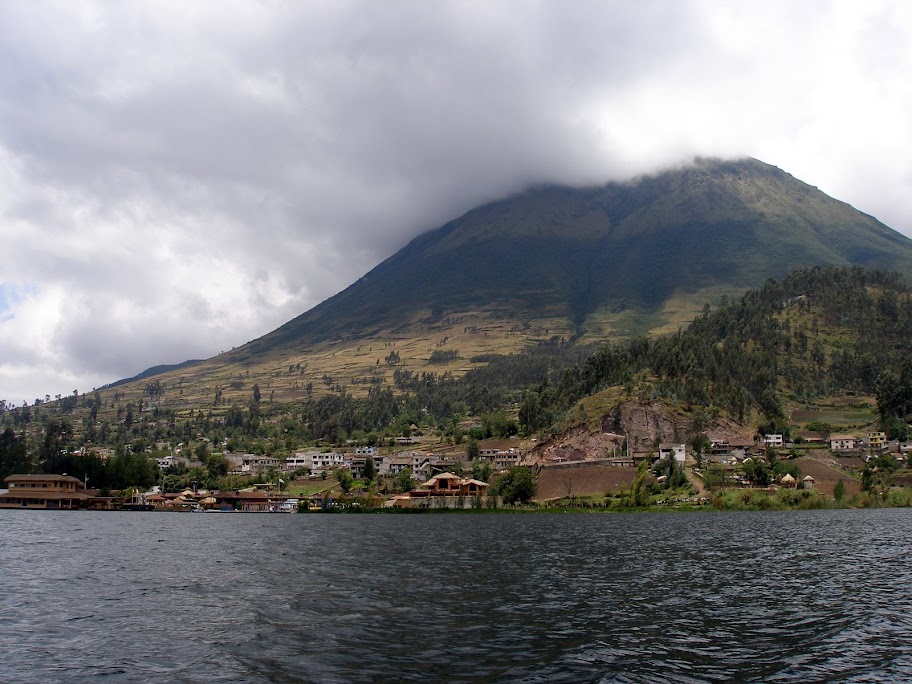
Later, after coming down from the mountain and then checking into our hostel (the same one we stopped at last time we were in Otavalo called Aya Humo), we took a bus ride to our first real paramo location, which was around a dormant (most likely extinct) volcano that had filled with water and become a lake. It was extremely foggy here. We got out of the bus and walked around a little bit and it didn't take long before we completely lost sight of the bus in the fog. It was kind of chilly there, and as expected there were mostly just grasses and shrubs scattering across the land. The shapes of the landscape that were partially hidden in the dense fog made the place seem almost mystical. It began to rain a little so we turned back to the bus and
Saturday
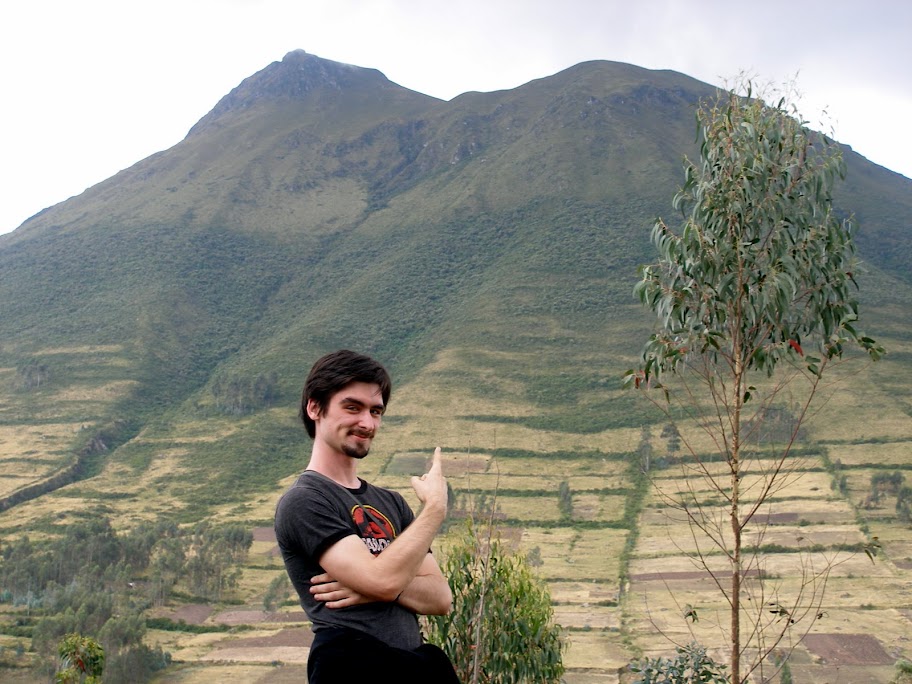
I had taken a shower the night before and went to bed with my hair still wet, so when I woke up in the morning, I had crazy hair. I decided not to tame it before going to breakfast. We checked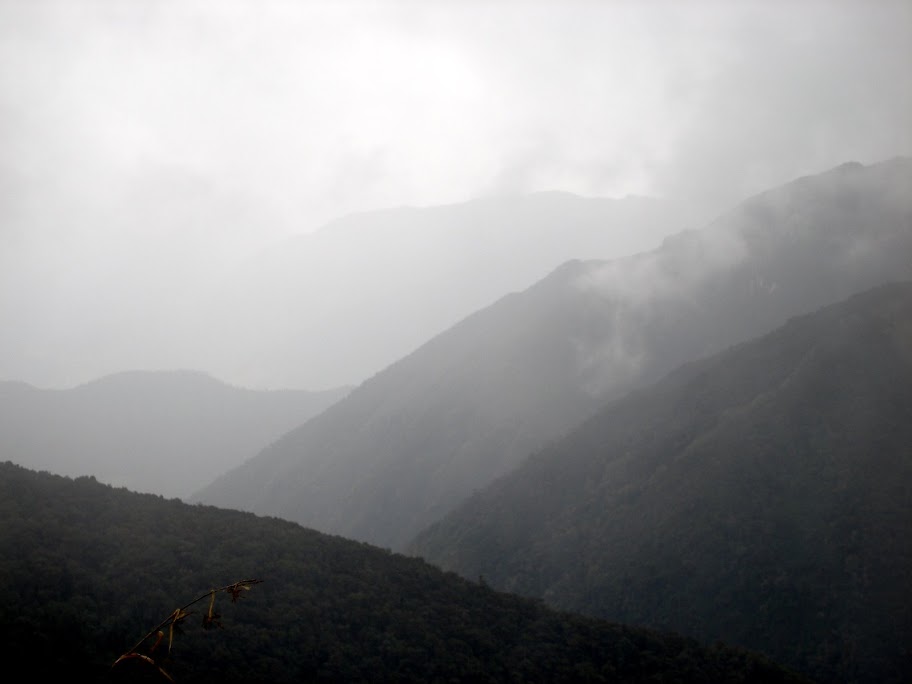
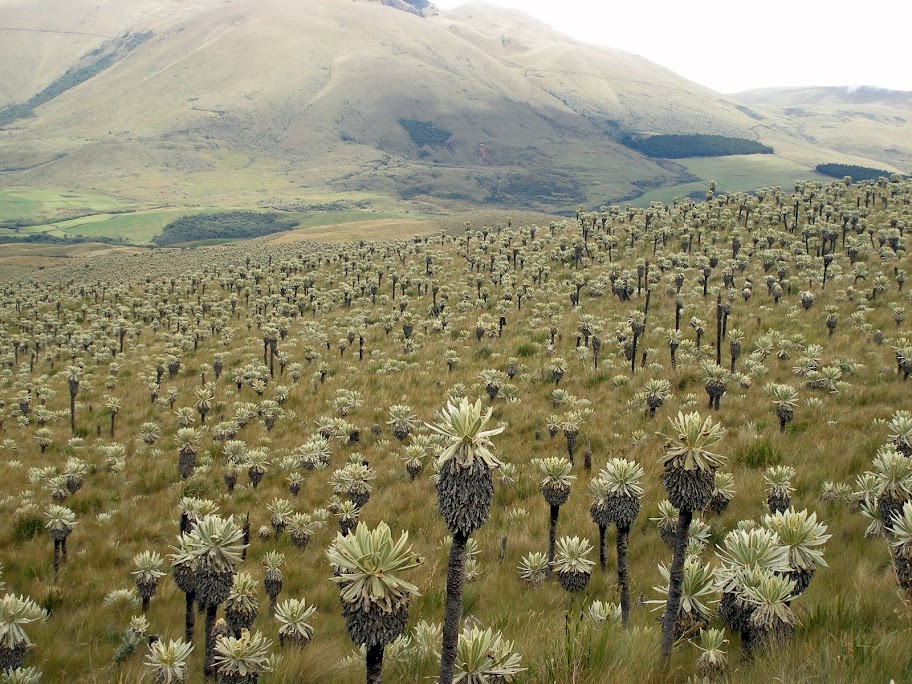
So there's a type of ecosystem that we've been learning about in 2 or 3 of our classes called the “paramo”, they described it to us as kind of a tundra-like environment but instead of being high in latitude, it's high in altitude. It's a relatively cold environment that sees more temperature change throughout the day than it does throughout the year. In a single day it can go from 0 to
22 degrees Celsius, so the life there has to be adapted to extreme and rapid temperature
fluctuation. The plant life is mostly made up of grasses and shrubs.
Friday
On the 10 of October, we embarked on our journey to the paramo. Meeting bright and early, we piled onto the charter bus that would take us there. This field trip was only for kids in the ecology program, so instead of there being the full 27 of us, there were 11, so we had some space to stretch out on the bus, which was quite nice, because especially in the beginning all we wanted to do was sleep and listen to music.
The first place we went was to Otavalo, where we had gone with the whole program about a month earlier. Here we picked up Cesar Cotocachi, who was our guide last time too. With him, we went
to a lake that was going through a restoration project. We got in a little boat and drove around the lake while Cesar told us about the lake and the restoration project. I appeared to be paying
close attention, but the truth was I was all the way in the back of the boat and the motor was
quite loud. It was a really nice boat ride, we were at the base of the great big mountain that we had seen last time we were in Otavalo. I still don't know what that mountain's called.
After the boat ride, we went to a nearby restaurant that was part of a hostel that was right
on the lake, literally. There were windows in the floor so we could see the water below. Lunch
was yummy, and afterward Cesar, deciding we needed to walk off the lunch, lead us on a hike up a bit of a mountain. The view from the top was breath taking, but we had already lost our breath on the way up there. We could see other mountains, villages, and lakes. It was also a good place to get a view of the really big mountain that I mentioned before. The air was nice and crisp, and the weather was perfect.
Later, after coming down from the mountain and then checking into our hostel (the same one we stopped at last time we were in Otavalo called Aya Humo), we took a bus ride to our first real paramo location, which was around a dormant (most likely extinct) volcano that had filled with water and become a lake. It was extremely foggy here. We got out of the bus and walked around a little bit and it didn't take long before we completely lost sight of the bus in the fog. It was kind of chilly there, and as expected there were mostly just grasses and shrubs scattering across the land. The shapes of the landscape that were partially hidden in the dense fog made the place seem almost mystical. It began to rain a little so we turned back to the bus and
headed back to the hostel, where we chilled until dinner time. This time I decided not to get the trout with the head and tail included and instead went for the chicken. The same kids sang and danced for us while we ate. This time I actually gave them a little donation. Before going to bed, I taught some people a fun Ecuadorian card game.
Saturday
I had taken a shower the night before and went to bed with my hair still wet, so when I woke up in the morning, I had crazy hair. I decided not to tame it before going to breakfast. We checked
out of the hostel and headed off to our next destination, which was further up in altitude. Along the way, we stopped and got out of the bus at various locations and Cesar told us a bit about the ecosystem and the people who lived nearby. One place we stayed a bit longer than the other places. This place was on top of a high ridge. We walked across a field, past some horses and came across a truly wondrous view. I took several pictures that I plan on stitching together to form a 360 degree view. After that stop, we were driving through a very beautiful land with very beautiful weather, so three of my friends and I, who were all sitting on the same side of the bus, spent a large time with our head sticking out the window, laughing and talking and taking pictures! It was fantastic and probably something we wouldn't be able to get away with in the
States.
Eventually we drove far enough that the weather started to change, we were now in a place that was colder and foggier. We stopped kind of in the middle of nowhere and Cesar took us on our second big hike of the trip—up a decently-sized mountain. The terrain was steep and muddy. Most of the way up we were in what I think is officially called a tropical humid cloud forest,
Eventually we drove far enough that the weather started to change, we were now in a place that was colder and foggier. We stopped kind of in the middle of nowhere and Cesar took us on our second big hike of the trip—up a decently-sized mountain. The terrain was steep and muddy. Most of the way up we were in what I think is officially called a tropical humid cloud forest,
meaning everything was wet and muddy. It took a little under an hour to get to the top. Near the top, we hit the tree line and the land was taken over by the grasses and shrubs of the paramo. At the high altitude it took us a little while to rest and catch our breath, but the view was something else. With clouds all around, we could see the distant silhouettes of the other mountains all around us. It was well worth the climb, we were all feeling really good once we'd gotten to the top. Plenty of pictures were taken of course. The way back down was easier on our
muscles, though a lot more caution had to be paid to not slipping down on the mud. Several of us did slip, though, including myself. Back down at the bus, we ate a lunch that we brought with us. It included fruit juice, pb+j sandwiches, tuna, pears, bananas, chips, and cool containers of Ecuadorian snacks that involved beans and toasted corn kernels. Yum. The bus then brought us to a place called the Polilepis Lodge – Private and Protected Ecological Reserve at an altitude of 3581 meters above sea level. We got to our cabin (the boys and girls had separate cabins), it was kind of off in the woods and the bathroom smelled like black mold, so we kept the door closed and took care of business outside or in the bathroom we found in the main lodge. Apparently the girls got a really nice bathroom with a tub. Figures. We started a fire in the wood stove, because it was freezing in the cabin. After getting back from dinner that evening, the cabin was nice and toasty, I barely used my covers that night.
Sunday
In the morning after breakfast, we put on our rubber boots and a guide from the hostel took us on a tour through the ecological reserve. At the altitude of the cabins, he brought us through a forest that had many polilepis trees, which are crooked trees growing at high altitudes that have flaky, layered, papery bark. They look cool, especially with moss growing all over them. On the walk we came across several ponds and swamps. When we climbed a little bit out of the forest, we encountered a new type of plant, called a “frailejone”. These things were everywhere, and you'll have to look at the pictures to see what they look like, but apparently they're pretty
Sunday
In the morning after breakfast, we put on our rubber boots and a guide from the hostel took us on a tour through the ecological reserve. At the altitude of the cabins, he brought us through a forest that had many polilepis trees, which are crooked trees growing at high altitudes that have flaky, layered, papery bark. They look cool, especially with moss growing all over them. On the walk we came across several ponds and swamps. When we climbed a little bit out of the forest, we encountered a new type of plant, called a “frailejone”. These things were everywhere, and you'll have to look at the pictures to see what they look like, but apparently they're pretty
common in paramo regions. The guide took us to a ridge. The climb up was a little steeper than the mountain from the day before, but it wasn't nearly as long of a walk. The view was extraordinary, words cannot describe it. Luckily there are pictures. We walked along the ridge to a less-steep path that would take us back to the main cabin compound. Along the ridge we saw a group of people clustered around a girl who was lying on the ground. They were crying and wrapping jackets around her. She wasn't dead, but she had passed out. This was a group of vacationers from the coast, and right now they were about 4000 meters above sea level, where there's easily less than a third of the amount of oxygen that they're used to. Some of the girl's companions had torn down an old fence to use the wood for a stretcher, but in the end, she was carried down the ridge in a blanket. On our way down, we passed several of her friends, most of who were crying or hyperventilating. Some were doing both, they did not seem to be doing well. All we could think of was how grateful we were to have had the chance to acclimate to the Quito altitude before going on this trip.
The incident on the ridge was not the last we saw of this group of fain travelers. After our hike, we ate lunch in the main lodge, where these people were resting in the lounge. All of a sudden, all within five minutes, there were cries of horror and three people were carried out completely unconscious, a fourth, who was very close to unconsciousness was dragged out by his buddy. People from the group were beside themselves, crying and hyperventilating like crazy, looking very uneasy. Meanwhile, we sat completely fine with the altitude, eating our lunch, trying not to pay too much attention, though at the same time, staring and wondering what would happen next.
We never did exactly find out what happened next, after lunch it was time to go, for we had a 6-hour bus ride back to Quito. We packed up our things and got on the bus and had a nice, relaxing trip back. We assume that an ambulance or two or three came and picked up the unfortunate travelers from the coast and brought them down to a lower altitude and gave them plenty of oxygen, though we can't say for sure.
Our ride back to Quito was pretty uneventful, most of us slept and listened to music. I got home, had a nice little dinner with my family and told them as best I could of our adventures.
I hope you all are doing well.
Stay tuned, and don't worry, you won't have to wait over two weeks for my next entry.
Check out the pictures!
~Joey
The incident on the ridge was not the last we saw of this group of fain travelers. After our hike, we ate lunch in the main lodge, where these people were resting in the lounge. All of a sudden, all within five minutes, there were cries of horror and three people were carried out completely unconscious, a fourth, who was very close to unconsciousness was dragged out by his buddy. People from the group were beside themselves, crying and hyperventilating like crazy, looking very uneasy. Meanwhile, we sat completely fine with the altitude, eating our lunch, trying not to pay too much attention, though at the same time, staring and wondering what would happen next.
We never did exactly find out what happened next, after lunch it was time to go, for we had a 6-hour bus ride back to Quito. We packed up our things and got on the bus and had a nice, relaxing trip back. We assume that an ambulance or two or three came and picked up the unfortunate travelers from the coast and brought them down to a lower altitude and gave them plenty of oxygen, though we can't say for sure.
Our ride back to Quito was pretty uneventful, most of us slept and listened to music. I got home, had a nice little dinner with my family and told them as best I could of our adventures.
I hope you all are doing well.
Stay tuned, and don't worry, you won't have to wait over two weeks for my next entry.
Check out the pictures!
~Joey
Sunday, October 5, 2008
Mindo
So this past weekend I went with my herpetology class on a field trip to a place near-ish to Quito called Mindo. Mindo is known for being an Andean cloud forest, meaning it's a relatively dense tropical type of forest that's found at a high elevation. There's a good bit of biodiversity and lots of clouds.
On Saturday, everyone in my herpetology class woke up bright and early and we all met at a bus station in the North of Quito. The ride to Mindo takes about 2 hours, it took us slightly longer because at one point in the road we came to a complete stop for a while and had to wait. I told my friends it was because there was a moose blocking the road, but it turned out to be a tractor trailer that seemed to have lost its trailer. Along the way, the scenery was gorgeous. The road we were on wound along the side of a mountain that was covered with beautiful exotic plants, such as ginormous ferns, and bright red bromiliads. As we drove closer to Mindo, we went down in elevation and the sky became much cloudier. In some places there was pretty dense fog as well. The town of Mindo itself is a cute little place with several restaurants and hostels. Parts that we'd seen looked relatively prepared for gringos. When we got off the bus, we started walking down a dirt road in the forest. I'm not good a judging distances, but it seemed like it could have been around a mile give or take. Finally we reached our hostel, a very nice little place in the middle of the forest that had stone and wood-walled buildings with thatched roofing. Outside of the check-in building were several humming bird feeders and over 20 humming birds flying around and having drinks.
We spent the day settling in, eating lunch, and getting briefed on the field work we'd be doing that night. We were there to test a hypothesis on variations in biodiversity of frogs in different habitats. We ate dinner and night rolled around. We split into our groups and headed off to our various assigned locations. I was with two other people and our area was a field on the side of a forest that had a creek flowing through it. We spent two hours walking slowly along the edge of the creek looking for frogs in the grass, the creek, and in the foliage of the nearby forest It was raining a little bit and my nose was running, but I had my poncho and rubber boots on, so I was pretty set. My group caught about 14 frogs of different types, including a tree frog and several yellow and black poison dart frogs (they're OK to pick up as long as you wash your hands before eating or touching your face). That night, our teacher identified most of them (they guy's a genius, I'd guess he's in his mid twenties and has already published 10 papers on lizards and amphibians). The next day we gathered in the morning and he showed us preservation techniques. We returned most of the frogs to their original habitats, but he kept a few that he wanted to bring back. First he euthenized them by putting some anesthesia on them for them to absorb through their skin. While they were groggy and unable to jump away, he would put them on some leaves and take pictures of them and let us take pictures too. Then when he was sure they were dead, he would extract a part of them to preserve for future DNA study. From the bigger frog he took the liver, and from the other, smaller frogs, he took one of the muscles from a leg. Then he went on to preserve the rest of the body with a technique that makes them last longer and makes them better for physiological study but damages the DNA. It was really interesting.
Overall it was a great trip, we got to see the cool landscape and plant life of Mindo, as well as catch a bunch of frogs. I know some people who went zip-lining through the forest there, that would be a fun thing to do some time. As always there're photos to be seen. Feel free to drop me a comment. Even if I don't get around to responding to all of them, I still appreciate hearing from you.
Take care everyone!
~Joey
On Saturday, everyone in my herpetology class woke up bright and early and we all met at a bus station in the North of Quito. The ride to Mindo takes about 2 hours, it took us slightly longer because at one point in the road we came to a complete stop for a while and had to wait. I told my friends it was because there was a moose blocking the road, but it turned out to be a tractor trailer that seemed to have lost its trailer. Along the way, the scenery was gorgeous. The road we were on wound along the side of a mountain that was covered with beautiful exotic plants, such as ginormous ferns, and bright red bromiliads. As we drove closer to Mindo, we went down in elevation and the sky became much cloudier. In some places there was pretty dense fog as well. The town of Mindo itself is a cute little place with several restaurants and hostels. Parts that we'd seen looked relatively prepared for gringos. When we got off the bus, we started walking down a dirt road in the forest. I'm not good a judging distances, but it seemed like it could have been around a mile give or take. Finally we reached our hostel, a very nice little place in the middle of the forest that had stone and wood-walled buildings with thatched roofing. Outside of the check-in building were several humming bird feeders and over 20 humming birds flying around and having drinks.
We spent the day settling in, eating lunch, and getting briefed on the field work we'd be doing that night. We were there to test a hypothesis on variations in biodiversity of frogs in different habitats. We ate dinner and night rolled around. We split into our groups and headed off to our various assigned locations. I was with two other people and our area was a field on the side of a forest that had a creek flowing through it. We spent two hours walking slowly along the edge of the creek looking for frogs in the grass, the creek, and in the foliage of the nearby forest It was raining a little bit and my nose was running, but I had my poncho and rubber boots on, so I was pretty set. My group caught about 14 frogs of different types, including a tree frog and several yellow and black poison dart frogs (they're OK to pick up as long as you wash your hands before eating or touching your face). That night, our teacher identified most of them (they guy's a genius, I'd guess he's in his mid twenties and has already published 10 papers on lizards and amphibians). The next day we gathered in the morning and he showed us preservation techniques. We returned most of the frogs to their original habitats, but he kept a few that he wanted to bring back. First he euthenized them by putting some anesthesia on them for them to absorb through their skin. While they were groggy and unable to jump away, he would put them on some leaves and take pictures of them and let us take pictures too. Then when he was sure they were dead, he would extract a part of them to preserve for future DNA study. From the bigger frog he took the liver, and from the other, smaller frogs, he took one of the muscles from a leg. Then he went on to preserve the rest of the body with a technique that makes them last longer and makes them better for physiological study but damages the DNA. It was really interesting.
Overall it was a great trip, we got to see the cool landscape and plant life of Mindo, as well as catch a bunch of frogs. I know some people who went zip-lining through the forest there, that would be a fun thing to do some time. As always there're photos to be seen. Feel free to drop me a comment. Even if I don't get around to responding to all of them, I still appreciate hearing from you.
Take care everyone!
~Joey
Sunday, September 28, 2008
...And the results are in!
So, voting for the new constitution happened today and the exit polls were announced at 5pm. According to them, the constitution passed by a pretty big margin. The official counts will be released later but I don't think it will change anything, we've got ourselves a new constitution. Now I just have to figure out how that affects me. A lot of people say that around here even if there are new political policies, in reality not much changes. We'll see how a new constitution affects the country. I'm wondering if we'll see Correa (the president) get kicked out of power, or if the adoption of the new constitution will go over relatively well with all the "No" votes. Ecuadorians have a habbit of straight-up kicking out presidents they don't like. Whatever happens I'll make sure to keep you all updated.
Tidbit: Apparently it's illegal here (and other countries) to make soda with high fructose corn syrup because of the harm it causes the human body. Instead soda is made with real sugar. It has a slightly different taste, but I like it. Also you can find quite a variety of bottle sizes here. Not only are there 1 liter and 2 liter, but I've also seen 1.5, 2.5, and maybe the weirdest: 1.35 liters.
Tidbit: Apparently it's illegal here (and other countries) to make soda with high fructose corn syrup because of the harm it causes the human body. Instead soda is made with real sugar. It has a slightly different taste, but I like it. Also you can find quite a variety of bottle sizes here. Not only are there 1 liter and 2 liter, but I've also seen 1.5, 2.5, and maybe the weirdest: 1.35 liters.
Wednesday, September 24, 2008
Tidbits!
Hey all! It's me again just giving a little update to the blog. I've been here about 40 days, and the mentality is starting to show. For example, just yesterday I was watching a TV show in which a woman drank water straight from the faucet. I wanted to reach into the screen and tell her not to do it until I realized that it was OK to drink the water where she was, as opposed to here where you really have to be careful. The city doesn't have any real tap-water sanitation program so if you drink straight from the tap, you can say good bye to your good health for a while, until they flush the amoebas and what not out of you.
Another example of me getting too comfortable here is that a few weeks ago I was in a grocery store and I made a comment in English about the guy in line in front of me. Most of the time I can get away with this because of that whole different language thing, but then I realized he was from the States. Oops. At least I didn't say anything too embarrassing, I had just been commenting on how much money he was paying. We said hi to each other and it wasn't that big of a deal, but it may just have saved me from a much more awkward situation in the future.
An interesting law came to pass last Monday: street sellers are no longer allowed to enter buses to sell things. If this happens, the driver of the bus is fined 20 bucks and two points are taken from his license. While this has reduced the number of sellers I've seen, they're not completely gone. They still come on the bus from time to time, in fact I just bought a bag of chips from one last night on my way home. The bus driver is too busy driving to kick off the vendors. Maybe after a few fines the drivers might crack down a bit more on who can come on their bus, but so far I've seen a general ignorance of this law, and who can blame them? It's not like their killing people or selling drugs, and for many of them it's just what they do to scrape together some cash to make their living.
Speaking of not paying attention to laws, in general road laws are pretty relaxed around here. I've never seen anyone pulled over for a speeding ticket or a busted tail light. In fact seat belts aren't even mandatory. My family doesn't really use them, and to be honest I'm not entirely sure that the seat belts work in our car. My father has been known to get away with running a red light several times without receiving anything worse than an “Aye papí! El semáforo!” (the traffic light!) from my host mom. But worry not for my road safety, I've only seen two car accidents during my whole time here, and one of those wasn't even in Quito and the other was during a rainy night. People are so used to how everyone else drives that although it would be considered bad driving in other places, it's normal driving here, and some strange sort of harmony has risen from the chaos.
In other news, this Sunday the whole country will vote on a new constitution. Really exciting stuff. The media is flooded with propaganda for the “Si” and the “No” vote. I'm sure many of you know the feeling back home. The interesting thing is that in Ecuador, voting is mandatory. Now at first, that seems like a really good idea, because nothing says “Democracy” more than every citizen putting in their ballot. But, unfortunately this mandatory voting thing may not actually be so hunky-dory. A large portion of the population is of low economic class and uneducated. This means that they're probably not paying close attention to politics and when voting day comes along, you'll find a large number of the citizens making uninformed decisions. Politics are also a lot more mean down here, and by that I mean there are politicians throughout Ecuador who say that if the vote ends up a certain way, they will leave office. Additionally, I heard that the president made an announcement that if the constitution passed, he would double the amount of money that natives receive, but if it doesn't pass, they'll get nothing. Yeah, in the States, we'd probably call that corruption or mass bribery or something along those lines. Personally, I think it would be interesting to see the constitution pass only because it would be unique to witness first-hand what it's like for a country to adopt a new constitution. On the other hand, it seems like many of the people who've actually read the thing are very much against it, so although it may be entertaining for me, it might not be in the country's best interest to adopt it. We'll see. I personally have not read the new constitution, but I do have a copy of it sitting on by bedside table in the case of a rare bout of insomnia. To put it in few words, from what I can tell, it's generally a pretty far-left-leaning document. I'll make sure to let you all know how this important vote turns out. Right now I wouldn't be surprised if it passed, because the government is putting a lot of effort into this campaign, and the whole mandatory vote thing that I talked about earlier. The whole country is taking this very seriously, to the extent that nobody is allowed to be intoxicated in public, it's going to be a dry weekend for the whole country so that people can make as much of a sober decision as possible. I think that's a cool idea. I'll be the bars feel differently (unless the president is subsidizing them temporarily to make up for the lost profit – it wouldn't be the first thing that's subsidized in this country).
On an unrelated note, today I definitely saw a guy riding down the street on a bicycle that had a lawn mower tied to the back. I don't mean he was dragging the mower behind him, it was like perched atop the bike rack that goes over the rear wheel. What makes this even better? This wasn't the first time I'd seen someone transporting a lawn mower by carrying it on their bicycle. Yessiree people do get creative down here.
One last thing: today I finished my first piece in my jewelery class, here's a pic!
Another example of me getting too comfortable here is that a few weeks ago I was in a grocery store and I made a comment in English about the guy in line in front of me. Most of the time I can get away with this because of that whole different language thing, but then I realized he was from the States. Oops. At least I didn't say anything too embarrassing, I had just been commenting on how much money he was paying. We said hi to each other and it wasn't that big of a deal, but it may just have saved me from a much more awkward situation in the future.
An interesting law came to pass last Monday: street sellers are no longer allowed to enter buses to sell things. If this happens, the driver of the bus is fined 20 bucks and two points are taken from his license. While this has reduced the number of sellers I've seen, they're not completely gone. They still come on the bus from time to time, in fact I just bought a bag of chips from one last night on my way home. The bus driver is too busy driving to kick off the vendors. Maybe after a few fines the drivers might crack down a bit more on who can come on their bus, but so far I've seen a general ignorance of this law, and who can blame them? It's not like their killing people or selling drugs, and for many of them it's just what they do to scrape together some cash to make their living.
Speaking of not paying attention to laws, in general road laws are pretty relaxed around here. I've never seen anyone pulled over for a speeding ticket or a busted tail light. In fact seat belts aren't even mandatory. My family doesn't really use them, and to be honest I'm not entirely sure that the seat belts work in our car. My father has been known to get away with running a red light several times without receiving anything worse than an “Aye papí! El semáforo!” (the traffic light!) from my host mom. But worry not for my road safety, I've only seen two car accidents during my whole time here, and one of those wasn't even in Quito and the other was during a rainy night. People are so used to how everyone else drives that although it would be considered bad driving in other places, it's normal driving here, and some strange sort of harmony has risen from the chaos.
In other news, this Sunday the whole country will vote on a new constitution. Really exciting stuff. The media is flooded with propaganda for the “Si” and the “No” vote. I'm sure many of you know the feeling back home. The interesting thing is that in Ecuador, voting is mandatory. Now at first, that seems like a really good idea, because nothing says “Democracy” more than every citizen putting in their ballot. But, unfortunately this mandatory voting thing may not actually be so hunky-dory. A large portion of the population is of low economic class and uneducated. This means that they're probably not paying close attention to politics and when voting day comes along, you'll find a large number of the citizens making uninformed decisions. Politics are also a lot more mean down here, and by that I mean there are politicians throughout Ecuador who say that if the vote ends up a certain way, they will leave office. Additionally, I heard that the president made an announcement that if the constitution passed, he would double the amount of money that natives receive, but if it doesn't pass, they'll get nothing. Yeah, in the States, we'd probably call that corruption or mass bribery or something along those lines. Personally, I think it would be interesting to see the constitution pass only because it would be unique to witness first-hand what it's like for a country to adopt a new constitution. On the other hand, it seems like many of the people who've actually read the thing are very much against it, so although it may be entertaining for me, it might not be in the country's best interest to adopt it. We'll see. I personally have not read the new constitution, but I do have a copy of it sitting on by bedside table in the case of a rare bout of insomnia. To put it in few words, from what I can tell, it's generally a pretty far-left-leaning document. I'll make sure to let you all know how this important vote turns out. Right now I wouldn't be surprised if it passed, because the government is putting a lot of effort into this campaign, and the whole mandatory vote thing that I talked about earlier. The whole country is taking this very seriously, to the extent that nobody is allowed to be intoxicated in public, it's going to be a dry weekend for the whole country so that people can make as much of a sober decision as possible. I think that's a cool idea. I'll be the bars feel differently (unless the president is subsidizing them temporarily to make up for the lost profit – it wouldn't be the first thing that's subsidized in this country).
On an unrelated note, today I definitely saw a guy riding down the street on a bicycle that had a lawn mower tied to the back. I don't mean he was dragging the mower behind him, it was like perched atop the bike rack that goes over the rear wheel. What makes this even better? This wasn't the first time I'd seen someone transporting a lawn mower by carrying it on their bicycle. Yessiree people do get creative down here.
One last thing: today I finished my first piece in my jewelery class, here's a pic!

Tuesday, September 16, 2008
A weekend in Otavalo
SATURDAY - We all woke up bright and early and met down at Quicentro, a major mall in the area. 27 zombie-like K students greeted each other and piled onto the private bus. It was about a 2 hour drive from Quito to Otavalo. Along the way we stopped at a beautiful rest stop that had a fantastic view of a great mountain and a distant lake. There were also llamas and cows there. There were two native girls that we picked up at the rest stop and they sang for us in Quichua for the remaining 10 to 20 minutes of the trip. We also picked up our guide, Cesar along the way.
Once in the Otavalo area, the first place we stopped was a live animal market. There were turkeys, ducks, chickens being held upside-down by their legs, cats, dogs, guinea pigs, regular pigs, and cows. It was really interesting to be walking around this place knowing that most of these animals would be sold and killed for food. Some people took that fact better than others.
Next we went to a market that sold pants, shirts, knick-knacks, art, musical instruments, souvenirs, hats, and tons of other things. It was located in a central plaza in Otavalo and through many streets coming out of the plaza. Every seller had a tent with all of there things crammed in there on carts and tables. It wasn't uncommon to see many different tents throughout selling the same things. One of the most fun things about this place is that we're expected to barter with the sellers. We regrouped and showed off everything we'd gotten. A popular item were these really zany pants made out of light material. All had vertical stripes of varying fun colors.
Cesar then took us to a place that was run by his family. Part of the place was kind of like a museum, showing off different aspects of Quichuan life, like spinning alpaca wool, ancient pottery (we got to hold one that I believe was 2000 years old), musical instruments, a stone corn grinder, which is something that women have to master before getting married, and others. We also ate lunch at this place. The food was yummy, it was chicken, some other meat, some veggies, and some oregano tea. In the back was a garden full of beautiful flowers. I took a bunch of pictures there. There was also a hut with some guinea pig pens in it.
We hopped back on the bus and headed towards Parque Condor, a sanctuary for raptors. I was excited not only to see the Andean Condor, the official bird of Ecuador with a wingspan of about 10 feet, but also the Harpy Eagle, which is apparently capable of eating small children. There was an amphitheater on a bit of a cliff, and this is where we were given a demonstration of different birds. The trainers would kind of throw the bird off the cliff. It would disappear for a few seconds and then soar up in the air. One bird was really good at catching food that the trainer threw up in the air. After the demonstration, some smaller birds were brought out and we were allowed to hold them and get our pictures taken with them.
We departed from the park and drove only a little way before getting out and climbing up a hill. On top of the hill was a sacred tree that was over 200 years old. The hill had a breath-taking 360 view, and there was quite a bit of interesting history behind it, for example it was a burial ground for babies back in the day. Also people who got caught for doing something bad to the natives would be tied to the tree naked all night long. They would have cold water thrown on them throughout the night and also be beaten. There was a really cool mountain seen from the top of the hill and I took a few pictures of that. Unfortunately its name was in Quichua and I don't remember what it was.
Finally it was time to go to our hotel. The hotel wasn't a big building like you'd find in the States, but rather a compound of buildings in a very rustic setting. There were hammocks outside of many of the rooms. The hotel had its own restaurant, where we ate. We were entertained by some really good music typical of the area. Also several kids danced for us. We had several options for dinner, and I chose the trout. Imagine my surprise when I found out that it was served with the head and tail still attached!
By the end of dinner everyone was pretty exhausted, we'd had a pretty big day, but it wasn't over yet. We had an evening activity planned: a demonstration of spiritual cleansing by an authentic shaman. Now, when I first heard about this, what came to mind was us sitting around in a temple of sorts with a man dressed head-to-toe in very shaman-esque clothing. What it turned out to be was us sitting around in a guy's living room. His house wasn't particularly nice, the furniture was uncomfortable and there were flies all around. Our shaman was an older man with a button-down shirt with a design of an eagle combating a snake in a lightning storm. For the ceremony he wore a headdress that wasn't in the best of conditions.
The Ceremony: First the shaman passed around a bowl of strong alcohol for us all to have a sip (“medicine of the ancestors”, as he called it), then the volunteer (one of us) stripped down to their undergarments, and one of the first things the shaman did was spit, no, spray alcohol all over the volunteer's body. It was hard not to laugh. I don't know what we were expecting, but it wasn't this. We pulled ourselves together quickly and watched as the shaman shook two eggs all around the body of the volunteer, then rub burnt bundles of plants all over their body, breathe fire towards their body, and of course spit more alcohol over them. The ceremony had a very unique method of timing how long each phase should last: the time it took to smoke a cigarette. That's right, the shaman would start smoking a cigarette and then do his thing, like rubbing plants all over the person's body and he would only stop when his cigarette went out. Then he'd light up another and start on the next phase. Sometimes he'd blow smoke over the person's body as well. At the end, the person had to drink a concoction that may or may not have been a mixture of the strong alcohol and cologne. To top it off, the person whose spirit has been cleansed was not supposed to shower for three days. As far as I know, they all followed that rule (I think there might have been 6 in total).
It turns out that he usually doesn't do the ceremonies in his living room, but there's a smaller room where he does it for smaller groups. We got to look in and there were a lot of dead things hanging on the walls, including armadillos and animal skins. There was even a jaguar paw hanging on the wall.
Exhausted, stunned, and in some cases spiritually cleansed, we all climbed into the bus for the last time that day and headed back to the hotel, where we enjoyed our sleep very much.
SUDNAY - On Sunday, we woke up earlier than we wanted to (6:30) and went to breakfast at 7. I wore my new zany blue-striped pants that I'd gotten at the market the day before. We moved out of the hotel and went to a fruit market that had tons of people with their carts selling fruits of all types and colors. It was really cool. It wasn't only a fruit market, but a dead animal market (probably where some of those animals we saw the day before end up). There were several butcheries, and outside the doorway of one was a dog sitting patiently for some scraps. Some people had a bag full of dead, plucked chickens. They'd take them out one at a time, chop off the head and the legs at the knees and then put the body in a pile on their cart next to the rest of the dead, plucked, headless, legless chickens. We also saw several pig heads, some with skin and some without skin.
After another bus ride, we found ourselves at a place that looked like a really nice park, except I think people actually lived there. It had a good-sized waterfall and we all took pictures of each other in front of it. Then we climbed up a steep path that went up the side of the waterfall and over the top of it to the other side. We met a sweet black dog. It followed us around everywhere, even up the really steep path. I'm not sure how exactly it did it, but then again it does live there, so it's probably been everywhere.
The next stop was a place where musical instruments are made, a woman showed us how pan pipes are made and then she demonstrated different instruments. I got to try out an instrument that resembled a didgeridoo in front of everyone.
We ate lunch in a town called Cotocachi, a place that is known for its leather. After lunch we watched a parade and walked down a street that had tons of leather shops.
Our last stop before returning to Quito was a great big dormant volcano that had filled up with water and become a lake. We got on a boat and rode around the lake, which had two islands. We were able to see bubbles coming up from the water and in some places it smelled a bit like sulfur. The bubbles were volcanic, coming from way down deep in the Earth. After getting out of the boats, we took a little hike along the rim of the volcano, where we not only got a great view of the lake and islands, but also of the land around the volcano. We were able to see the great big mountain that we'd seen the day before from atop the sacred hill.
Even though my weekend was fantastic, when I got home I was so excited to see my room and my bed again. It had seemed like a long time since I'd been here even though it was two days.
As always, check out my picasa page for pics!
Once in the Otavalo area, the first place we stopped was a live animal market. There were turkeys, ducks, chickens being held upside-down by their legs, cats, dogs, guinea pigs, regular pigs, and cows. It was really interesting to be walking around this place knowing that most of these animals would be sold and killed for food. Some people took that fact better than others.
Next we went to a market that sold pants, shirts, knick-knacks, art, musical instruments, souvenirs, hats, and tons of other things. It was located in a central plaza in Otavalo and through many streets coming out of the plaza. Every seller had a tent with all of there things crammed in there on carts and tables. It wasn't uncommon to see many different tents throughout selling the same things. One of the most fun things about this place is that we're expected to barter with the sellers. We regrouped and showed off everything we'd gotten. A popular item were these really zany pants made out of light material. All had vertical stripes of varying fun colors.
Cesar then took us to a place that was run by his family. Part of the place was kind of like a museum, showing off different aspects of Quichuan life, like spinning alpaca wool, ancient pottery (we got to hold one that I believe was 2000 years old), musical instruments, a stone corn grinder, which is something that women have to master before getting married, and others. We also ate lunch at this place. The food was yummy, it was chicken, some other meat, some veggies, and some oregano tea. In the back was a garden full of beautiful flowers. I took a bunch of pictures there. There was also a hut with some guinea pig pens in it.
We hopped back on the bus and headed towards Parque Condor, a sanctuary for raptors. I was excited not only to see the Andean Condor, the official bird of Ecuador with a wingspan of about 10 feet, but also the Harpy Eagle, which is apparently capable of eating small children. There was an amphitheater on a bit of a cliff, and this is where we were given a demonstration of different birds. The trainers would kind of throw the bird off the cliff. It would disappear for a few seconds and then soar up in the air. One bird was really good at catching food that the trainer threw up in the air. After the demonstration, some smaller birds were brought out and we were allowed to hold them and get our pictures taken with them.
We departed from the park and drove only a little way before getting out and climbing up a hill. On top of the hill was a sacred tree that was over 200 years old. The hill had a breath-taking 360 view, and there was quite a bit of interesting history behind it, for example it was a burial ground for babies back in the day. Also people who got caught for doing something bad to the natives would be tied to the tree naked all night long. They would have cold water thrown on them throughout the night and also be beaten. There was a really cool mountain seen from the top of the hill and I took a few pictures of that. Unfortunately its name was in Quichua and I don't remember what it was.
Finally it was time to go to our hotel. The hotel wasn't a big building like you'd find in the States, but rather a compound of buildings in a very rustic setting. There were hammocks outside of many of the rooms. The hotel had its own restaurant, where we ate. We were entertained by some really good music typical of the area. Also several kids danced for us. We had several options for dinner, and I chose the trout. Imagine my surprise when I found out that it was served with the head and tail still attached!
By the end of dinner everyone was pretty exhausted, we'd had a pretty big day, but it wasn't over yet. We had an evening activity planned: a demonstration of spiritual cleansing by an authentic shaman. Now, when I first heard about this, what came to mind was us sitting around in a temple of sorts with a man dressed head-to-toe in very shaman-esque clothing. What it turned out to be was us sitting around in a guy's living room. His house wasn't particularly nice, the furniture was uncomfortable and there were flies all around. Our shaman was an older man with a button-down shirt with a design of an eagle combating a snake in a lightning storm. For the ceremony he wore a headdress that wasn't in the best of conditions.
The Ceremony: First the shaman passed around a bowl of strong alcohol for us all to have a sip (“medicine of the ancestors”, as he called it), then the volunteer (one of us) stripped down to their undergarments, and one of the first things the shaman did was spit, no, spray alcohol all over the volunteer's body. It was hard not to laugh. I don't know what we were expecting, but it wasn't this. We pulled ourselves together quickly and watched as the shaman shook two eggs all around the body of the volunteer, then rub burnt bundles of plants all over their body, breathe fire towards their body, and of course spit more alcohol over them. The ceremony had a very unique method of timing how long each phase should last: the time it took to smoke a cigarette. That's right, the shaman would start smoking a cigarette and then do his thing, like rubbing plants all over the person's body and he would only stop when his cigarette went out. Then he'd light up another and start on the next phase. Sometimes he'd blow smoke over the person's body as well. At the end, the person had to drink a concoction that may or may not have been a mixture of the strong alcohol and cologne. To top it off, the person whose spirit has been cleansed was not supposed to shower for three days. As far as I know, they all followed that rule (I think there might have been 6 in total).
It turns out that he usually doesn't do the ceremonies in his living room, but there's a smaller room where he does it for smaller groups. We got to look in and there were a lot of dead things hanging on the walls, including armadillos and animal skins. There was even a jaguar paw hanging on the wall.
Exhausted, stunned, and in some cases spiritually cleansed, we all climbed into the bus for the last time that day and headed back to the hotel, where we enjoyed our sleep very much.
SUDNAY - On Sunday, we woke up earlier than we wanted to (6:30) and went to breakfast at 7. I wore my new zany blue-striped pants that I'd gotten at the market the day before. We moved out of the hotel and went to a fruit market that had tons of people with their carts selling fruits of all types and colors. It was really cool. It wasn't only a fruit market, but a dead animal market (probably where some of those animals we saw the day before end up). There were several butcheries, and outside the doorway of one was a dog sitting patiently for some scraps. Some people had a bag full of dead, plucked chickens. They'd take them out one at a time, chop off the head and the legs at the knees and then put the body in a pile on their cart next to the rest of the dead, plucked, headless, legless chickens. We also saw several pig heads, some with skin and some without skin.
After another bus ride, we found ourselves at a place that looked like a really nice park, except I think people actually lived there. It had a good-sized waterfall and we all took pictures of each other in front of it. Then we climbed up a steep path that went up the side of the waterfall and over the top of it to the other side. We met a sweet black dog. It followed us around everywhere, even up the really steep path. I'm not sure how exactly it did it, but then again it does live there, so it's probably been everywhere.
The next stop was a place where musical instruments are made, a woman showed us how pan pipes are made and then she demonstrated different instruments. I got to try out an instrument that resembled a didgeridoo in front of everyone.
We ate lunch in a town called Cotocachi, a place that is known for its leather. After lunch we watched a parade and walked down a street that had tons of leather shops.
Our last stop before returning to Quito was a great big dormant volcano that had filled up with water and become a lake. We got on a boat and rode around the lake, which had two islands. We were able to see bubbles coming up from the water and in some places it smelled a bit like sulfur. The bubbles were volcanic, coming from way down deep in the Earth. After getting out of the boats, we took a little hike along the rim of the volcano, where we not only got a great view of the lake and islands, but also of the land around the volcano. We were able to see the great big mountain that we'd seen the day before from atop the sacred hill.
Even though my weekend was fantastic, when I got home I was so excited to see my room and my bed again. It had seemed like a long time since I'd been here even though it was two days.
As always, check out my picasa page for pics!
Friday, September 12, 2008
Bad dream, glad I woke up!
So last night I had this dream that went a little something like this: First I realize I'm in the US and I find it strange that I still have some things like my Ecuadorian cell phone with me, because I meant to leave that in Ecuador when I left. Secondly I start remembering things that I wanted to do while I was in Ecuador that I never got to accomplish. Then I start wondering why on Earth I thought I'd be able to have enough time to do these things. I soon came upon the answer: because I was supposed to be in Ecuador for a longer period of time. For some reason I had returned to the States after only a month in Ecuador! I started getting mad because I hadn't even gotten a chance to say good bye to my host family, and although it was nice to see everyone back home in the States, I felt really cheated because I was supposed to be in Ecuador for another five months! I got in contact with a woman in charge here and our conversation went a little something like this:
"Why are we here?!"
"What do you mean?"
"Why aren't we in Quito right now?!"
"Oh, the program got canceled and we brought you guys home early."
"WHAT! WHY?"
"Some students just weren't responsible enough to be there."
Oh, I was so mad. Why did they have to bring all of us back just because a few students couldn't stay? By the end of the dream I told myself that some day I'd return to Ecuador and do the things I wanted to do.
You have no idea how happy I was to wake up from that dream. I miss a lot of you back home, but there is NO way that I'm ready to leave.
---
This weekend we're going on a trip with the program to a place called Otavalo, a little town outside of Quito. Apparently it has a really cool market place and a park for birds of prey. I'll make sure to write a good blog entry and put up lots of pictures when I get back. We leave bright and early Saturday morning and get back Sunday evening.
Tidbit: Every morning for breakfast I get a good-sized bowl of yogurt, filled with pieces of fresh fruit (I've had apple, banana, kiwi and papaya, just to name a few) and with granola sprinkled on top. Also my host mother makes me delicious scrambled eggs, sometimes with scallions and sometimes with small strips of ham cooked right in there. I also get a glass of fresh-squeezed orange juice, and if that doesn't fill me up, there's always fresh bread from a nearby bakery and cheese and homemade jam to put on top. It's so good, or as the Ecuadorians would say, ¡Que rico!
Take care everyone, and check back in early next week to find out what happens in Otavalo!
-Joey
"Why are we here?!"
"What do you mean?"
"Why aren't we in Quito right now?!"
"Oh, the program got canceled and we brought you guys home early."
"WHAT! WHY?"
"Some students just weren't responsible enough to be there."
Oh, I was so mad. Why did they have to bring all of us back just because a few students couldn't stay? By the end of the dream I told myself that some day I'd return to Ecuador and do the things I wanted to do.
You have no idea how happy I was to wake up from that dream. I miss a lot of you back home, but there is NO way that I'm ready to leave.
---
This weekend we're going on a trip with the program to a place called Otavalo, a little town outside of Quito. Apparently it has a really cool market place and a park for birds of prey. I'll make sure to write a good blog entry and put up lots of pictures when I get back. We leave bright and early Saturday morning and get back Sunday evening.
Tidbit: Every morning for breakfast I get a good-sized bowl of yogurt, filled with pieces of fresh fruit (I've had apple, banana, kiwi and papaya, just to name a few) and with granola sprinkled on top. Also my host mother makes me delicious scrambled eggs, sometimes with scallions and sometimes with small strips of ham cooked right in there. I also get a glass of fresh-squeezed orange juice, and if that doesn't fill me up, there's always fresh bread from a nearby bakery and cheese and homemade jam to put on top. It's so good, or as the Ecuadorians would say, ¡Que rico!
Take care everyone, and check back in early next week to find out what happens in Otavalo!
-Joey
Saturday, September 6, 2008
Sí se puede, Ecuador!
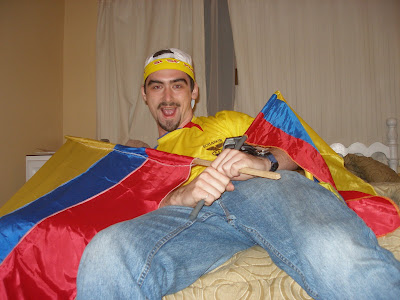 Hola todos! Today was the big futbol, er, I mean soccer match between Ecuador and Bolivia, and I went with all of my friends. The game started at 4:10, but we had to get there around 2-ish to get seats. We were all wearing our bright yellow Ecuador jerseys and ready for a good time. Before the game I had also bought a hat and a flag, each for a dollar. At exciting moments I would jump up to my feet and wave the flag as hard as I could.
We learned some popular chants from a nearby crowd of enthusiastic fans. Some of the transations were roughly: "You can do it!", "Stand up, Ecuador!", "Let's go Ecuadorians, it's your mission, we have to win!", and of course "ECUADOR! ECUADOR! ECUADOR!". These same spirited ecuadorians sitting near us were also really good at starting the wave, which we were able to make go around the whole stadium seve
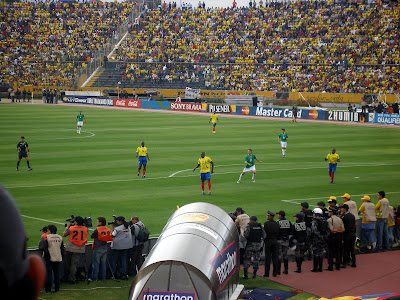 ral consecutive times.
Watching soccer is crazy, it's like life or death for the players, they will do whatever it takes to win. So when the ball was looking like it was heading towards our goal, instead of letting the goalie try to stop it, like might happen in a high school soccer match, one of our players came out of nowhere and did some super crazy kick to make sure the ball stayed way out of there. I think the ball ended up leaving the field in some weird direction, and so did the player, he was one of three who were injured enough in the first half to be carried off the field on a stretcher (the other two were Bolivians).
I'm sure you all are wondering who won. We did of course! The final score was 3 to 1, as predicted by Neil. Everyone was so happy as we poure
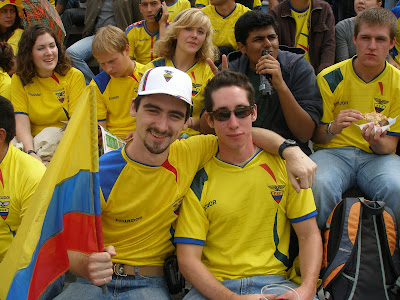 d out of that stadium. On my way home I bought two headbands (25 cents each) and another flag, this one much bigger, which was originally 5 bucks but I got it down to 3. Walking from the bus stop to my house, I trailed both flags behind me, as I proudly marched up the street, wearing my bright yellow jersey with red and blue on it.
As always, there are pictures on my picasa page of the game. Check 'em out!
~Joey
Subscribe to:
Comments (Atom)
